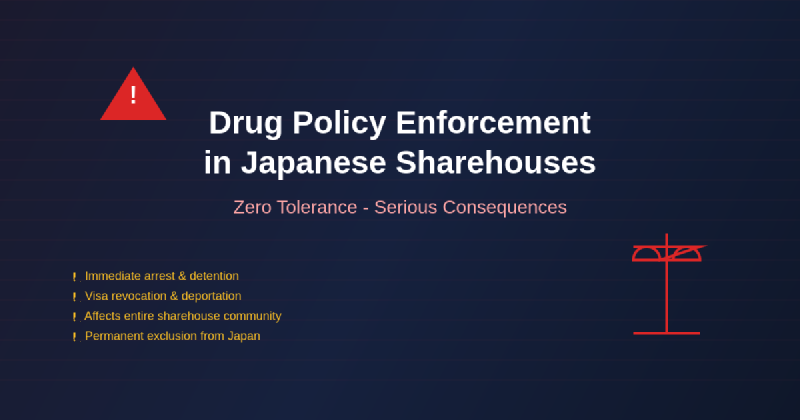
Japan maintains one of the world’s most stringent drug enforcement policies, creating an environment where even minor infractions can result in severe legal consequences that extend far beyond criminal penalties to include deportation, visa revocation, and permanent exclusion from the country. For international residents living in sharehouses, understanding these policies becomes crucial not only for personal legal protection but also for maintaining housing stability and protecting fellow residents from collective consequences that can affect entire sharehouse communities.
The intersection of Japan’s drug laws with sharehouse living creates unique challenges and responsibilities that many international residents fail to fully comprehend until they encounter enforcement situations firsthand. The communal nature of sharehouse living means that individual violations can impact multiple residents, property owners, and management companies, resulting in collective punishment scenarios that can displace entire communities and create lasting consequences for everyone involved.
Japan’s Zero-Tolerance Legal Framework
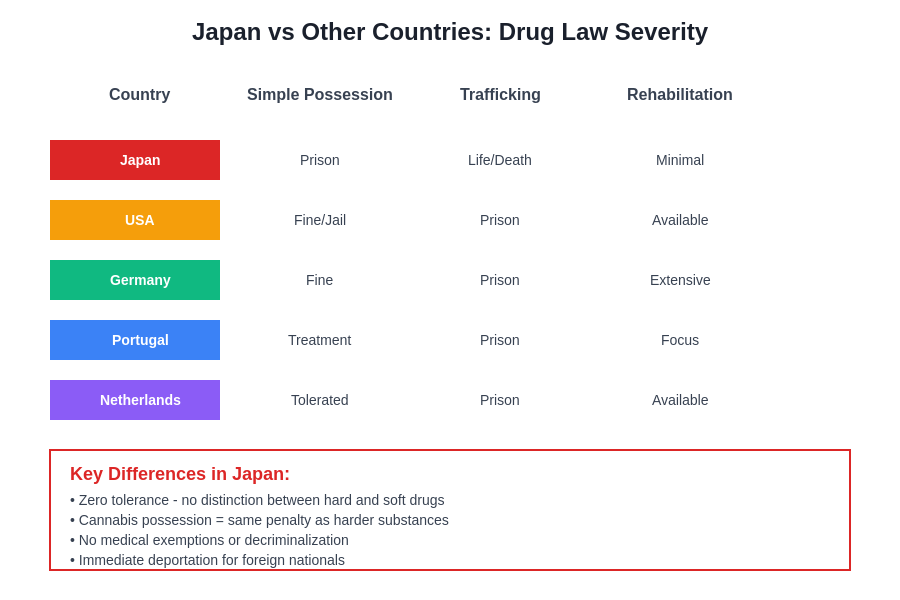
Japan’s drug enforcement approach operates under a comprehensive zero-tolerance philosophy that treats all controlled substances equally regardless of their legal status in other countries or the quantities involved in violations. The Narcotics and Psychotropics Control Law, along with supporting legislation, creates a legal environment where possession, use, distribution, or facilitation of any controlled substance results in immediate arrest, prosecution, and severe sentencing guidelines that prioritize deterrence over rehabilitation.
The legal framework encompasses not only traditional illegal drugs but also extends to prescription medications, over-the-counter supplements, and substances that may be legal or decriminalized in other jurisdictions. Japanese sharehouse rules every foreigner should know provides essential context for understanding how these national laws translate into specific housing regulations and enforcement mechanisms within sharehouse environments.
Cannabis, stimulants, narcotics, and psychotropic substances fall under different categories of controlled substances, each carrying specific penalty structures that can include years of imprisonment, substantial fines, and automatic deportation procedures for non-Japanese citizens. The law makes no distinctions for medical use, personal consumption, or quantities that might be considered minor in other legal systems, creating absolute liability scenarios where intent and circumstances provide minimal defense options.
International treaties and diplomatic agreements do not provide protection from Japanese drug laws, meaning that substances legal in your home country, including medical marijuana prescriptions or CBD products, become illegal contraband upon entry into Japanese territory. The enforcement system operates with presumptions of guilt that place the burden of proof on defendants to demonstrate their innocence, reversing typical legal presumptions found in many Western legal systems.
Sharehouse-Specific Enforcement Mechanisms
Sharehouse operators implement comprehensive drug policy enforcement systems that extend beyond simple prohibition statements to include active monitoring, reporting obligations, and immediate removal procedures designed to protect property licenses and maintain operational compliance with local authorities. Living costs in Tokyo sharehouses explained touches on how enforcement costs and insurance requirements affect overall housing expenses and operational structures.
Property management companies face legal obligations to report suspected drug activity to law enforcement agencies, creating situations where staff members actively monitor resident behavior, investigate suspicious activities, and collaborate with police investigations that can result in comprehensive searches of entire properties. These reporting requirements eliminate confidentiality expectations and create environments where any suspicious behavior can trigger formal investigations affecting all residents.
Random inspections, both announced and unannounced, form standard operating procedures for many sharehouses, particularly those housing international residents who are perceived as higher-risk populations by enforcement agencies. These inspections can include searches of individual rooms, common areas, and personal belongings, often conducted in coordination with immigration authorities who can initiate deportation procedures based on inspection findings.
Resident reporting systems encourage and sometimes require housemates to report suspicious activities, creating social dynamics where normal privacy expectations become compromised and community relationships can be strained by enforcement obligations. How to handle roommate conflicts without moving out becomes particularly relevant when enforcement policies create tensions between residents who may have different cultural expectations regarding privacy and personal autonomy.
Individual Consequences and Legal Penalties
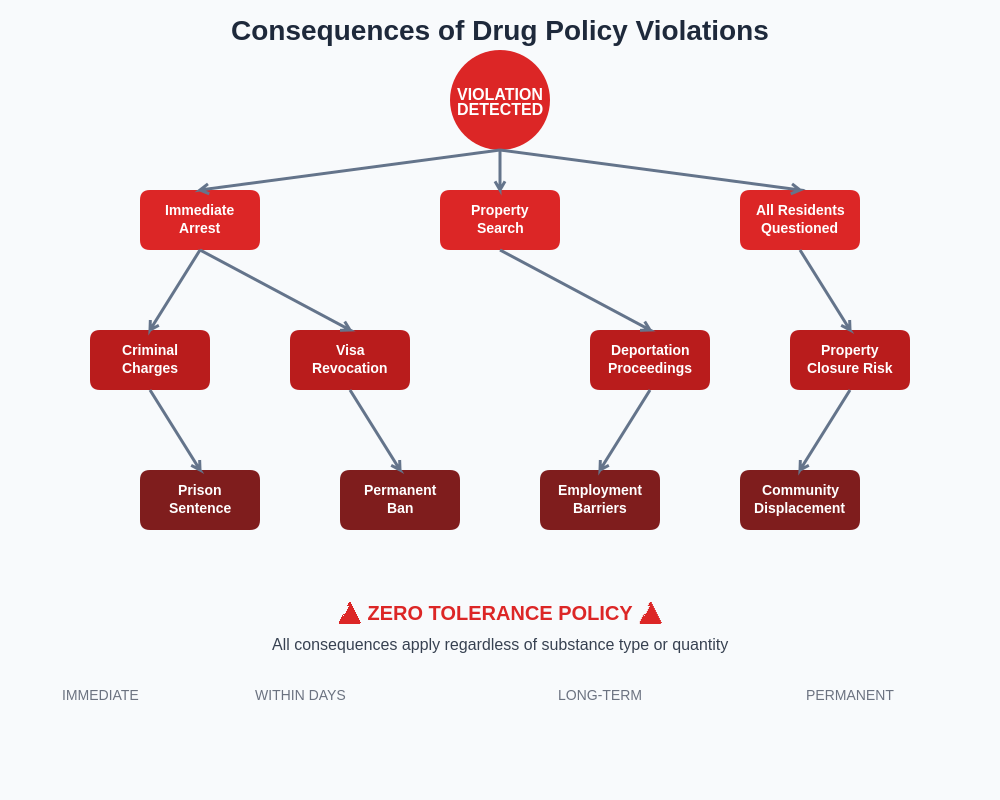
Drug law violations in Japan result in immediate arrest procedures that can include extended detention periods without bail, limited access to legal representation, and interrogation processes that can continue for weeks without formal charges being filed. The Japanese legal system allows for prolonged detention periods designed to encourage confession and cooperation, creating psychological pressure that can lead to admissions of guilt regardless of actual culpability.
Criminal penalties for drug violations typically include substantial prison sentences that range from several months to multiple years depending on the substance involved and the circumstances of the violation. Financial penalties can reach millions of yen, creating debt obligations that can follow individuals for decades and impact their ability to rebuild their lives after serving criminal sentences.
Visa revocation procedures begin immediately upon arrest, regardless of the ultimate outcome of criminal proceedings, meaning that even charges that are later dropped or result in acquittals can still lead to deportation and permanent exclusion from Japan. Why immigration status changes affect your lease explains how legal troubles can cascade into housing instability and financial obligations that persist even after deportation.
Professional consequences extend beyond criminal penalties to include employment termination, professional license revocation, and permanent barriers to future employment in regulated industries. Many employers conduct regular background checks and drug testing, meaning that violations can affect career prospects for years or decades after the initial incident, creating long-term economic impacts that extend far beyond immediate legal penalties.
Collective Impact on Sharehouse Communities
Drug law violations by individual residents can trigger comprehensive investigations that affect entire sharehouse properties, resulting in searches of all resident rooms, interrogation of all community members, and potential closure of properties that are deemed to facilitate illegal activities. Real stories from Tokyo sharehouse residents includes accounts of how individual violations have disrupted entire communities and displaced dozens of residents who had no connection to illegal activities.
Property operators may face license revocation, criminal charges for facilitating illegal activities, and civil liability for damages resulting from drug-related incidents on their properties. These risks create incentives for extremely strict enforcement policies and zero-tolerance approaches that prioritize property protection over resident rights or due process considerations.
Insurance complications can arise when drug violations occur on sharehouse properties, potentially leaving operators and residents without coverage for property damage, personal injury, or legal defense costs associated with enforcement actions. What security deposits actually cover in sharehouses explains how drug-related incidents can result in financial obligations that exceed normal security deposit amounts and create unexpected costs for departing residents.
Community displacement scenarios can develop rapidly when properties are deemed problematic by authorities, forcing residents to find alternative housing on short notice while dealing with potential legal complications that can affect their ability to secure new accommodations. The stigma associated with drug-related incidents can follow residents to new housing applications, creating barriers to finding suitable alternative accommodations.
Prevention and Compliance Strategies
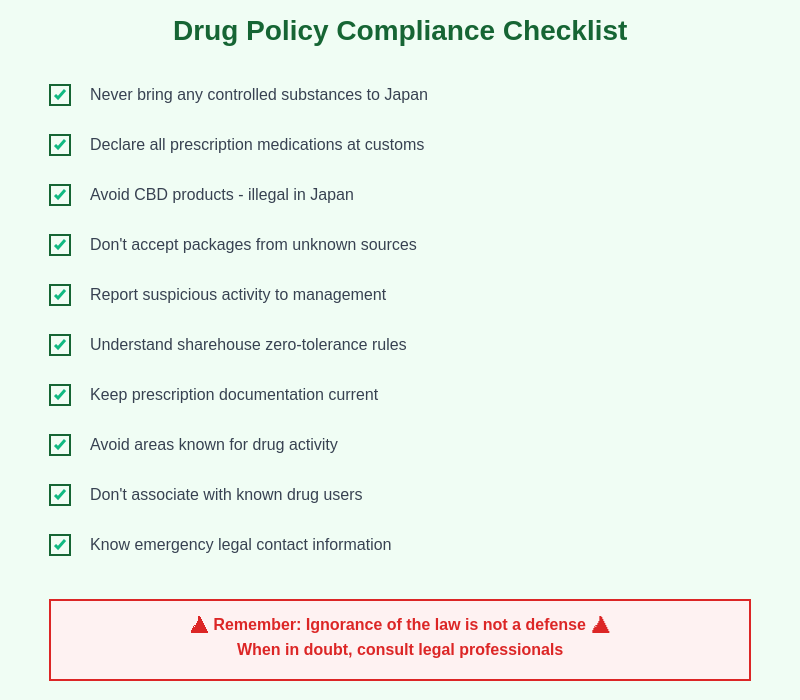
Effective compliance with Japan’s drug policies requires comprehensive understanding of prohibited substances, including medications, supplements, and products that may be legal in other countries but are controlled in Japan. What documents you need for Tokyo sharehouse applications includes information about declaring medications and obtaining proper permits for substances that may require special authorization.
Prescription medication management requires careful documentation, proper import procedures, and regular review of changing regulations that can affect previously approved substances. International residents must maintain current prescriptions, proper documentation, and awareness of quantity limitations that can affect their ability to bring necessary medications into the country or obtain refills while residing in Japan.
Social awareness programs within sharehouse communities help educate residents about legal requirements, reporting obligations, and consequences of violations that can affect everyone in the property. Making friends through Tokyo sharehouse communities discusses how community education and mutual support can help prevent violations while maintaining positive social relationships among residents.
Legal consultation services provide essential guidance for international residents who need clarity about specific substances, situations, or compliance requirements that may not be covered by general educational materials. Understanding when and how to seek legal advice can prevent violations and provide protection when questions arise about potentially problematic situations or substances.
Enforcement Technology and Monitoring Systems
Modern enforcement systems incorporate advanced detection technologies including drug-detecting equipment, surveillance systems, and chemical analysis capabilities that can identify trace amounts of controlled substances in property environments. These technological capabilities mean that even minimal exposure or residual presence of prohibited substances can trigger enforcement actions and legal consequences.
Digital monitoring systems track package deliveries, monitor internet communications, and analyze behavioral patterns that may indicate drug-related activities, creating comprehensive surveillance environments that extend beyond physical property boundaries to include online activities and communication patterns. How package deliveries become complicated explains how international shipping can become problematic when enforcement agencies monitor incoming packages for prohibited substances.
Laboratory testing capabilities can detect incredibly small quantities of controlled substances, meaning that casual contact, shared spaces, or environmental exposure can result in positive tests that trigger legal consequences regardless of intentional use or possession. Understanding these detection capabilities helps residents appreciate the importance of complete avoidance and environmental awareness in shared living situations.
Coordination between law enforcement agencies, immigration authorities, and property management companies creates comprehensive monitoring networks that share information and coordinate enforcement actions across multiple jurisdictions and administrative systems. This coordination means that violations can trigger responses from multiple agencies simultaneously, creating complex legal situations that require specialized legal representation and can result in overlapping penalties and consequences.
Emergency Response and Crisis Management
When drug policy violations occur in sharehouse environments, immediate response protocols typically involve evacuation of residents, comprehensive property searches, and extended investigation periods that can disrupt housing stability for weeks or months. Emergency contact systems work in practice provides guidance on maintaining communication and support systems during crisis situations.
Legal representation becomes immediately necessary when violations occur, requiring residents to understand their rights, obtain qualified legal counsel, and navigate complex legal procedures while potentially facing detention, deportation, or criminal charges. Understanding how to access legal services and what to expect during legal proceedings can help residents protect their interests and minimize long-term consequences.
Alternative housing arrangements may become necessary immediately following enforcement actions, requiring residents to secure temporary accommodations while legal proceedings unfold and property access may be restricted. Short-term sharehouse options in Japan provides information about emergency housing alternatives that may be available during crisis situations.
Community support systems can provide essential assistance during enforcement crises, helping affected residents access legal services, find alternative housing, and maintain stability during what can be extended periods of uncertainty and legal complexity. Building these support networks before crises occur provides protection and assistance when they are most needed.
Long-term Consequences and Recovery
Drug policy violations create permanent records that affect future visa applications, employment opportunities, and housing eligibility both within Japan and internationally. How career changes affect sharehouse eligibility explains how legal records can create barriers to housing and employment that persist for years after initial violations occur.
International implications can include notification to home country authorities, impacts on security clearances, and barriers to international travel that extend beyond Japan’s borders to affect global mobility and opportunities. Understanding these international consequences helps residents appreciate the full scope of potential impacts and make informed decisions about compliance and risk management.
Financial recovery from drug policy violations can require years of effort to address criminal fines, legal fees, deportation costs, and lost income resulting from employment termination and housing displacement. How to budget realistically for sharehouse living includes considerations for emergency funds that can help residents manage unexpected legal and housing costs.
Rehabilitation and reintegration support services may be available through various organizations, but the stigma and legal barriers created by drug violations can make accessing these services challenging and limit their effectiveness in helping individuals rebuild their lives after enforcement actions.
The strict enforcement of drug policies in Japanese sharehouses reflects broader national priorities that prioritize public safety and social order through comprehensive deterrence and zero-tolerance approaches. For international residents, understanding these policies and their enforcement mechanisms becomes essential for maintaining legal compliance, protecting visa status, and preserving housing stability within sharehouse communities that can be collectively affected by individual violations.
Disclaimer
This article is for informational purposes only and does not constitute legal advice. Drug laws and enforcement policies in Japan are subject to change, and individual circumstances may affect legal outcomes. Readers should consult with qualified legal professionals for specific guidance regarding drug policy compliance and legal requirements. The information provided reflects general enforcement patterns but may not account for recent legislative changes or case-specific factors that could affect individual situations.