The pursuit of meaningful friendships in Tokyo sharehouses often encounters an invisible yet formidable obstacle that transcends cultural differences and personal compatibility: the language barrier. This linguistic divide creates complex layers of communication challenges that prevent residents from developing the deep, authentic connections they desperately seek during their international living experience. Understanding how language limitations systematically undermine friendship formation reveals the profound impact that communication skills have on social integration and emotional well-being in shared living environments.
The psychological and emotional consequences of language barriers extend far beyond simple communication difficulties, creating cascading effects that influence self-confidence, social participation, and long-term relationship building. These challenges become particularly pronounced in sharehouse settings where residents share intimate living spaces but struggle to bridge the communication gaps that separate their inner worlds from potential friendships.
The Surface Level Communication Trap
Language barriers create a deceptive situation where residents can successfully navigate daily practical conversations while remaining completely unable to access the emotional depth required for genuine friendship development. Living with Japanese roommates in Tokyo sharehouses demonstrates how surface-level interactions can mask profound communication limitations that prevent residents from truly knowing each other.
The ability to discuss practical matters such as cleaning schedules, utility bills, and house rules creates a false sense of communication competency that obscures deeper linguistic limitations. Residents often believe they are building relationships when they are actually engaging in functional exchanges that never progress beyond logistical coordination and polite pleasantries.
This surface-level communication trap becomes particularly problematic when residents mistake frequent interaction for meaningful connection. The daily conversations about weather, work schedules, and household matters create an illusion of friendship development that masks the absence of emotional intimacy and personal understanding that defines authentic relationships.
The frustration of being unable to express complex thoughts, emotions, and experiences creates a persistent sense of social isolation even within active social environments. Residents find themselves surrounded by potential friends but unable to bridge the gap between superficial interaction and genuine connection.
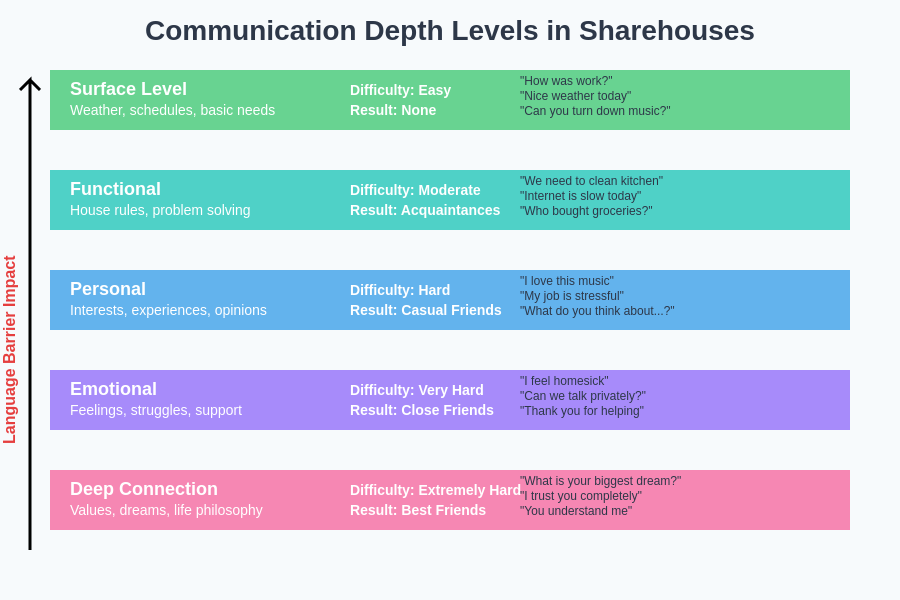
The progression from basic surface-level exchanges to deep emotional connection requires increasingly sophisticated language skills that many international residents have not yet developed, creating natural barriers at each communication level.
Emotional Expression Limitations and Relationship Depth
The inability to accurately express emotions, personal experiences, and complex thoughts in a shared language creates fundamental barriers to the vulnerability and authenticity required for deep friendship formation. Making friends through Tokyo sharehouse communities highlights how communication challenges affect the natural progression from acquaintanceship to meaningful friendship.
Emotional expression requires linguistic nuance, cultural context, and vocabulary precision that extends far beyond basic conversational ability. The fear of being misunderstood or appearing less intelligent due to language limitations often causes residents to avoid sharing personal experiences, emotional struggles, and meaningful life events that form the foundation of close relationships.
Language barriers prevent residents from engaging in the type of deep conversations that reveal personality, values, dreams, and fears essential for friendship development. Without the ability to share stories, discuss philosophical ideas, or express complex emotions, relationships remain trapped in a superficial zone that cannot evolve into genuine intimacy.
The emotional labor required to constantly translate thoughts, search for appropriate vocabulary, and worry about grammatical accuracy exhausts residents and makes spontaneous, authentic interaction nearly impossible. This cognitive burden transforms what should be enjoyable social interactions into stressful communication exercises that drain energy rather than build connections.
Cultural Context and Humor Translation Challenges
Language barriers become particularly pronounced when attempting to navigate cultural references, humor, and contextual understanding that require deep linguistic and cultural knowledge to appreciate and participate in meaningful ways. The inability to understand jokes, references, and cultural nuances creates constant reminders of outsider status that prevent full integration into social groups.
Humor represents one of the most challenging aspects of cross-cultural communication, requiring not only language proficiency but also cultural understanding, timing, and contextual awareness that takes years to develop. Cultural differences that affect friendship building explores how communication challenges interact with cultural barriers to create complex social dynamics.
The experience of missing punchlines, failing to understand references, or having one’s own attempts at humor fall flat creates cumulative social anxiety that discourages participation in group conversations and social activities. These repeated experiences of exclusion, even when unintentional, reinforce feelings of otherness that prevent genuine inclusion in social groups.
Cultural context extends beyond humor to include references to shared experiences, historical events, popular culture, and social norms that native speakers take for granted. The constant need to ask for explanations or pretend to understand disrupts natural conversation flow and highlights linguistic limitations.
The Confidence Erosion Cycle
Language barriers create a self-reinforcing cycle where communication difficulties erode self-confidence, leading to reduced social participation, which further limits language practice opportunities and relationship development. This downward spiral often traps residents in increasingly isolated situations despite their desire for social connection.
The fear of making grammatical errors, choosing wrong words, or being misunderstood causes many residents to self-censor and avoid initiating conversations or expressing opinions. Why some residents always feel like outsiders examines how communication challenges contribute to persistent feelings of social exclusion.
Self-consciousness about accent, pronunciation, and language ability often leads to speaking more quietly, avoiding group conversations, and declining social invitations. These protective behaviors, while understandable, further reduce opportunities for language improvement and relationship building.
The psychological impact of constantly feeling linguistically inadequate affects overall self-esteem and social confidence in ways that extend beyond language-specific situations. Residents begin to question their intelligence, personality, and social worth based on their communication limitations rather than recognizing these challenges as temporary linguistic barriers.
Misunderstanding and Conflict Escalation
Language barriers significantly increase the likelihood of misunderstandings that can escalate into serious conflicts and permanently damage potential friendships before they have opportunities to develop properly. The inability to clarify intentions, explain motivations, or resolve disputes through clear communication creates unnecessary relationship casualties.
Simple miscommunications about schedules, preferences, or expectations can become major conflicts when residents lack the linguistic tools to explain their perspectives or understand others’ viewpoints. How to handle roommate conflicts without moving out demonstrates how communication skills directly impact conflict resolution effectiveness.
The frustration of being unable to defend oneself, explain misunderstandings, or express sincere apologies in linguistically appropriate ways often leads to withdrawal from social interaction rather than attempting to resolve conflicts. This avoidance strategy prevents both conflict resolution and relationship repair.
Cultural differences in conflict resolution styles, combined with language barriers, create particularly complex situations where residents may unknowingly violate communication norms or fail to recognize attempts at reconciliation. These compounding factors make relationship recovery extremely difficult even when both parties desire resolution.
Group Dynamic Exclusion and Social Hierarchy
Language barriers inevitably create informal social hierarchies within sharehouses based on communication ability rather than personality compatibility, shared interests, or genuine friendship potential. Native speakers and highly proficient non-native speakers often form closer bonds that exclude those with limited language skills.
Group conversations naturally gravitate toward the communication comfort zone of the most linguistically limited participants, but often result in simplified discussions that fail to engage more advanced speakers. Why some conversations always stay surface level explores how language differences affect group communication dynamics.
The tendency for conversations to split into multiple simultaneous discussions based on language ability creates visible social divisions that reinforce feelings of exclusion and highlight linguistic inadequacy. Advanced speakers may unconsciously accelerate conversation pace or complexity, further marginalizing those with limited proficiency.
Social activities, entertainment choices, and shared experiences often cater to the linguistic majority, inadvertently excluding residents who cannot fully participate due to language limitations. This systematic exclusion prevents equal access to friendship-building opportunities and community integration.
Professional and Personal Identity Suppression
Language barriers force residents to suppress significant aspects of their professional expertise, personal interests, and individual identity that cannot be adequately expressed in their limited shared language. This identity suppression prevents others from truly knowing who they are beyond their linguistic limitations.
Professional accomplishments, specialized knowledge, and career experiences that define important aspects of personal identity become invisible when residents lack the vocabulary to discuss their expertise. Why some residents never ask questions examines how communication limitations affect intellectual engagement and professional discussions.
Personal interests, hobbies, and passions that could serve as natural conversation starters and friendship foundations remain unexpressed when residents cannot articulate their enthusiasm or knowledge in these areas. This limitation prevents potential friends from discovering shared interests and common ground.
The inability to share life stories, formative experiences, and personal values that shape individual identity creates relationships based on incomplete information and surface-level impressions rather than authentic understanding of who someone really is as a complete person.
Technology Dependence and Communication Authenticity
The increasing reliance on translation apps, language learning tools, and digital communication assistance creates an artificial layer between residents that can both help and hinder authentic relationship development. While technology provides valuable communication support, it can also create distance and reduce the spontaneity essential for natural friendship formation.
Real-time translation tools enable more complex conversations but often produce awkward phrasing, cultural misinterpretations, and emotional disconnect that feels artificial and forced rather than natural and authentic. The constant presence of technology mediating communication can prevent the organic flow necessary for genuine connection.
The time lag created by translation processes disrupts natural conversation rhythm and prevents the rapid-fire exchanges, interruptions, and overlapping dialogue that characterize close friendships and intimate conversations. How digital entertainment replaces social interaction explores how technology affects authentic social connection.
Over-dependence on technological assistance can actually slow language learning progress and maintain artificial communication barriers that prevent residents from developing the natural fluency necessary for spontaneous, authentic interaction.
Long-term Relationship Development Impacts
Language barriers create particularly significant obstacles to the long-term relationship development that transforms initial acquaintanceships into lasting friendships that extend beyond sharehouse living arrangements. The inability to deepen communication over time prevents relationships from evolving naturally.
As residents’ lives become more complex through career changes, relationship developments, personal challenges, and life transitions, the communication skills required to maintain friendships become increasingly sophisticated. Basic language ability that sufficed for initial interactions proves inadequate for supporting friends through difficult times or celebrating major life events.
The emotional support and advice-giving that characterizes close friendships requires linguistic nuance, cultural understanding, and communication sensitivity that extends far beyond practical conversation ability. Why some residents develop better communication skills examines factors that influence long-term language development and relationship success.
Long-distance friendship maintenance after residents move to different locations becomes nearly impossible when relationships were built on limited linguistic foundations that cannot support complex emotional communication through digital channels.
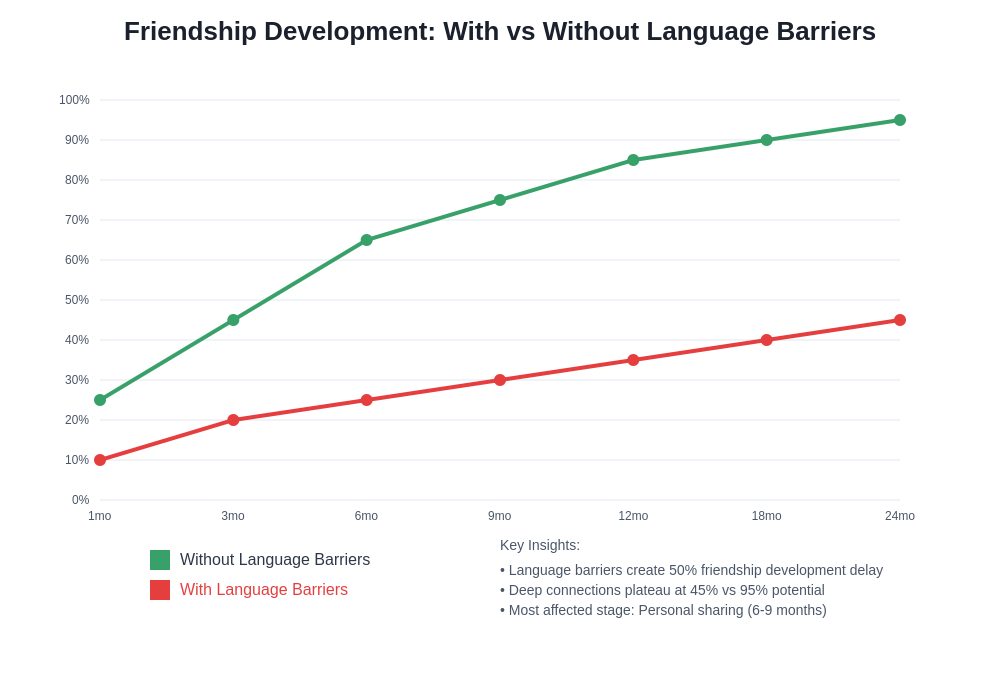
This timeline demonstrates the dramatic difference in relationship development speed and depth between residents who share fluent communication abilities versus those separated by language barriers. The gap widens significantly over time, preventing many potentially meaningful friendships from ever reaching their full potential.
Overcoming Strategies and Alternative Connection Methods
Despite significant challenges, some residents successfully develop meaningful friendships by implementing creative communication strategies that bypass traditional linguistic barriers while building language skills over time. These approaches recognize communication limitations while focusing on shared experiences and non-verbal connection methods.
Activity-based friendships built around shared hobbies, sports, cooking, or creative projects can develop emotional closeness through shared experiences rather than relying primarily on verbal communication. These relationships often provide safe spaces for language practice while building genuine connections through common interests.
Cultural exchange approaches where residents explicitly acknowledge language barriers and commit to mutual language learning can transform communication challenges into friendship-building opportunities. Language learning that affects career opportunities demonstrates how linguistic development benefits extend beyond social situations.
Patient, supportive friendship development that prioritizes understanding over perfect communication allows relationships to grow gradually while language skills improve naturally through increased interaction and mutual investment in overcoming barriers together.
The Hidden Emotional Toll and Mental Health Impact
The persistent frustration of being unable to form deep friendships due to language barriers creates significant emotional stress that affects mental health, self-worth, and overall satisfaction with the international living experience. This hidden emotional toll often goes unrecognized but profoundly impacts resident well-being.
Chronic social isolation disguised as busy social activity creates a particularly painful form of loneliness where residents are surrounded by people but feel fundamentally disconnected and misunderstood. The gap between desired social connection and actual relationship depth generates persistent dissatisfaction and sadness.
The constant cognitive effort required to navigate language barriers while attempting social connection becomes exhausting and can lead to social burnout where residents withdraw from interaction attempts entirely. Why some residents feel constantly judged explores the psychological impact of communication challenges on social confidence.
Long-term isolation from meaningful friendship can trigger depression, anxiety, and homesickness that significantly impact academic performance, career success, and overall life satisfaction during international experiences that were intended to be growth opportunities.
Understanding the profound ways that language barriers systematically prevent deep friendship formation helps residents, sharehouse operators, and international communities develop more effective support systems and communication strategies. Recognition of these challenges as legitimate obstacles rather than personal failures enables more compassionate approaches to cross-cultural relationship building and community integration.
The journey toward meaningful friendship across language barriers requires patience, creativity, and mutual commitment from all parties involved, but the rewards of successfully bridging these communication gaps create some of the most profound and lasting international friendships possible. These hard-won connections, built through overcoming significant obstacles together, often prove more resilient and meaningful than relationships formed without such challenges.
Recognizing these patterns and challenges represents the first step toward developing more effective strategies for cross-cultural friendship building. While language barriers create significant obstacles, awareness of their specific impacts enables residents, sharehouse communities, and support systems to develop targeted approaches that help bridge these communication gaps and foster the meaningful connections that international residents seek.
Disclaimer
This article is for informational purposes only and reflects common experiences with language barriers in international living situations. Individual experiences may vary significantly based on language learning ability, cultural background, and personal communication skills. The strategies mentioned may not be suitable for all situations, and readers should consider their specific circumstances when addressing communication challenges in cross-cultural relationships.