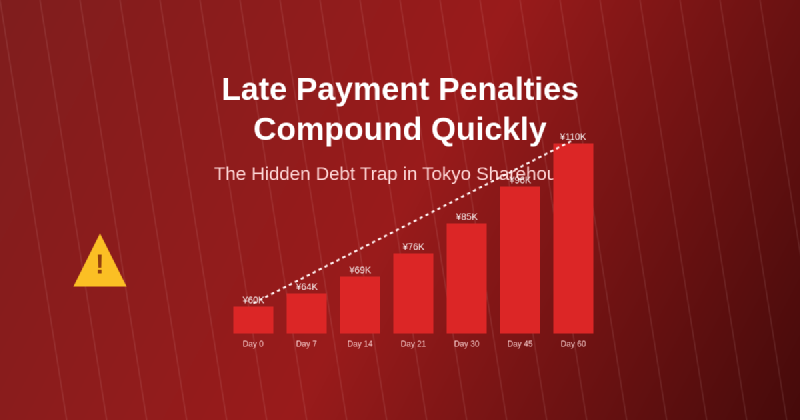
Late payment penalties in Tokyo sharehouses represent one of the most financially devastating traps that can destroy your budget and housing stability faster than most residents realize possible. What begins as a seemingly manageable delay in rent payment can escalate into thousands of yen in additional fees within just a few weeks, creating a spiral of debt that becomes increasingly difficult to escape and can ultimately lead to eviction and damaged rental history that affects future housing applications.
The mathematical reality of compounding penalties means that each day of delayed payment multiplies your financial burden exponentially, transforming what might have been a temporary cash flow issue into a long-term financial crisis that affects not only your current living situation but also your ability to secure alternative housing arrangements when the situation becomes untenable.
The Hidden Structure of Penalty Systems
Tokyo sharehouse operators employ sophisticated penalty structures designed to incentivize prompt payment while generating substantial additional revenue from residents who fall behind on their financial obligations. Understanding how much Tokyo sharehouses really cost per month becomes crucial when you realize that advertised monthly rates represent only the baseline cost before penalties are applied.
Most sharehouses implement multi-tiered penalty systems that begin with relatively modest late fees but escalate rapidly through various mechanisms including daily interest charges, administrative processing fees, and escalating penalty multipliers that can increase exponentially with each passing week. The initial late fee might seem reasonable at perhaps 1,000 to 3,000 yen, but this represents merely the beginning of a carefully constructed system designed to maximize revenue extraction from financially vulnerable residents.
Beyond basic late fees, operators frequently impose additional charges for payment processing, account management, communication attempts, and administrative overhead associated with collecting overdue payments. These supplementary fees often exceed the original late penalty and can accumulate independently, creating multiple streams of mounting debt that compound simultaneously and create overwhelming financial pressure.
The timing mechanisms employed by different operators vary significantly, with some calculating penalties from the original due date while others restart penalty calculations with each failed payment attempt. Understanding these timing structures becomes essential for residents attempting to minimize damage once they realize their payment will be delayed, as strategic timing can sometimes reduce overall penalty accumulation.
Daily Interest and Compounding Mathematics
The mathematical foundation of compounding penalties creates situations where debt grows exponentially rather than linearly, meaning that delays measured in weeks rather than days can result in penalty amounts that exceed the original rent payment by substantial margins. How to calculate your true living costs must include realistic assessments of potential penalty exposure when budgeting for sharehouse living.
Daily interest rates applied to overdue balances might appear minimal when expressed as percentages, but the compounding effect over extended periods creates substantial additional debt that many residents fail to anticipate when making decisions about payment timing. A daily interest rate of one percent might seem manageable, but over a thirty-day period this compounds to more than thirty-four percent additional debt beyond the original amount owed.
The compounding frequency employed by different operators significantly affects total penalty accumulation, with some calculating interest daily while others compound weekly or monthly. Daily compounding creates the most aggressive penalty growth, while monthly compounding provides residents with slightly more manageable debt accumulation patterns, though all compounding mechanisms result in substantial additional costs over extended periods.
Payment application methodologies further complicate penalty calculations, as some operators apply partial payments to penalties first while others apply payments to principal amounts first. Understanding these application rules becomes crucial when attempting to minimize ongoing penalty accumulation through partial payments or when negotiating payment arrangements with property management companies.
Administrative and Processing Fee Accumulation
Administrative fees associated with late payment collection often represent hidden penalty components that can exceed basic interest charges and create substantial additional financial burden beyond what residents anticipate when initially falling behind on payments. What additional fees really mean in practice provides essential insights into these often-overlooked cost components that can devastate carefully planned budgets.
Processing fees for payment attempts, whether successful or unsuccessful, can accumulate rapidly when residents attempt to resolve their overdue balances through multiple payment methods or installment arrangements. Each payment processing attempt might incur fees ranging from several hundred to several thousand yen, creating situations where attempting to resolve the debt actually increases the total amount owed.
Communication and notification fees charged for reminder notices, phone calls, and administrative correspondence can create substantial additional debt streams that operate independently of basic late fees and interest charges. Some operators charge for each attempt to contact residents about overdue payments, while others impose flat fees for administrative overhead associated with managing delinquent accounts.
Legal and collection fees begin accumulating once payment delays extend beyond operator-defined thresholds, typically ranging from thirty to ninety days depending on specific contract terms and company policies. These fees often include attorney consultation costs, formal notice preparation expenses, and potential court filing fees that can dwarf the original debt amount and create permanent financial consequences that extend beyond the immediate housing situation.
Real-World Penalty Escalation Examples
Practical examples of penalty escalation demonstrate how quickly manageable payment delays transform into overwhelming financial crises that can destroy housing stability and create long-term financial difficulties for residents who underestimate the aggressive nature of compound penalty systems. Living costs in Tokyo sharehouses explained often fails to adequately convey the potential magnitude of penalty-related costs that can accumulate during financial difficulties.
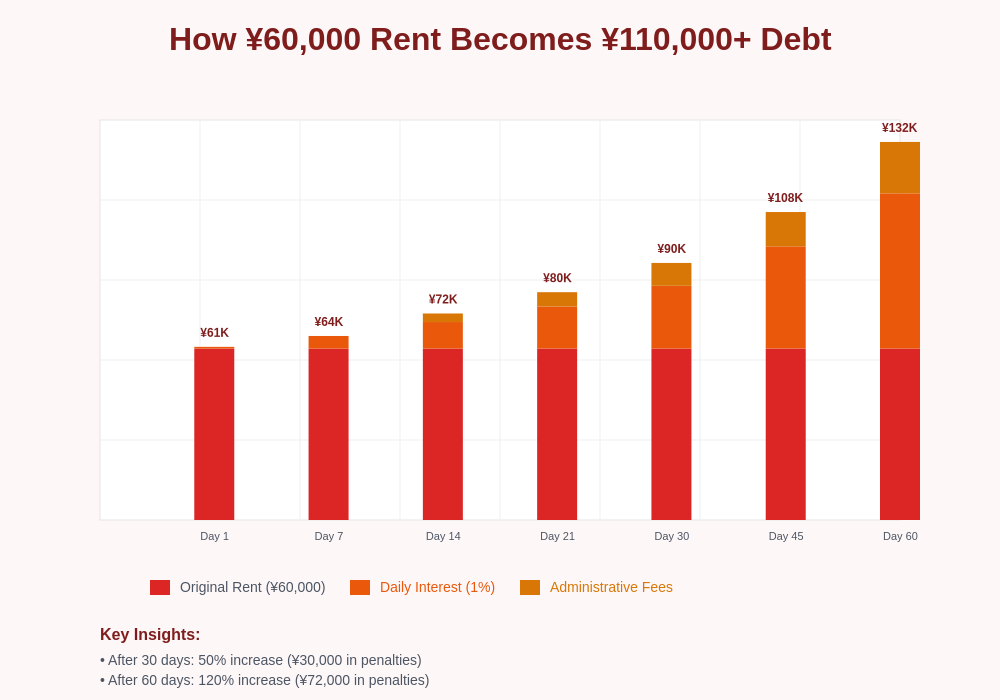
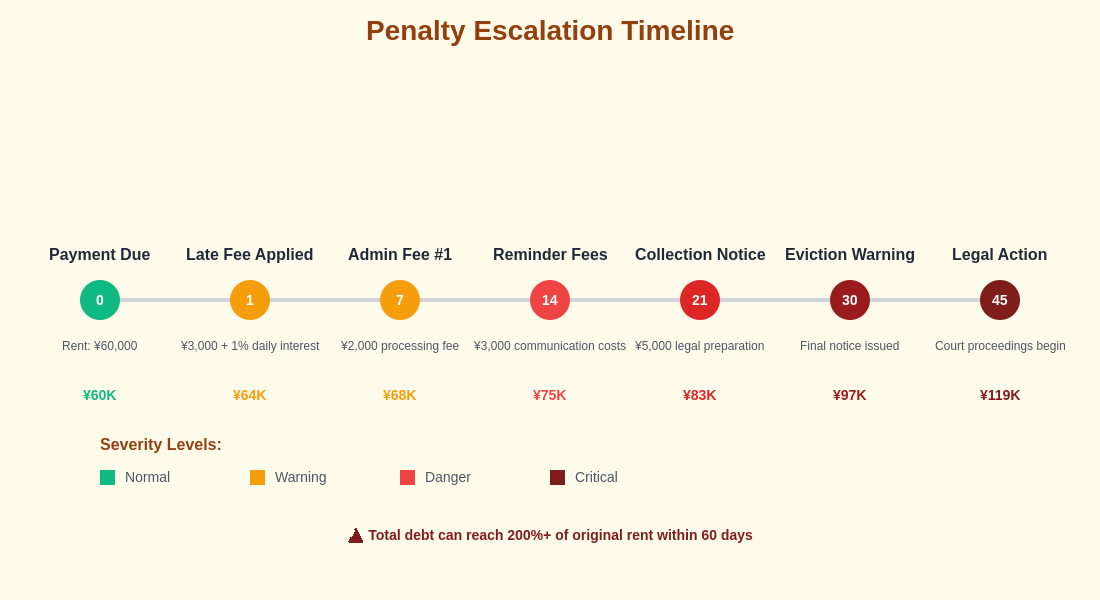
A typical scenario begins with a resident missing a 60,000 yen rent payment due to temporary cash flow issues, perhaps expecting to resolve the situation within a week or two. The initial late fee of 3,000 yen seems manageable, but daily interest at one percent begins accumulating immediately, adding approximately 630 yen per day to the outstanding balance. After just one week, the total debt has grown to over 64,400 yen before any additional administrative fees are applied.
By the second week, administrative processing fees for payment reminders and account management might add another 5,000 yen, while the daily interest continues accumulating on the growing balance. The total debt now exceeds 70,000 yen, representing more than sixteen percent growth beyond the original rent amount in just fourteen days, with acceleration continuing as the balance grows larger and interest compounds on the accumulated penalties.
After one month, the same 60,000 yen rent payment might result in total debt exceeding 85,000 yen when including accumulated daily interest, multiple administrative fees, collection costs, and potential legal preparation expenses. This represents more than forty percent growth beyond the original amount, with the penalty portion alone exceeding 25,000 yen in additional costs that could have covered nearly half of the following month’s rent payment.
Impact on Housing Stability and Future Applications
The consequences of accumulated late payment penalties extend far beyond immediate financial burden, creating lasting damage to rental history and creditworthiness that can affect housing applications for years after the initial payment difficulties are resolved. Why contract terms are more important than advertised prices becomes painfully apparent when residents discover how penalty clauses can destroy their housing stability and future rental prospects.
Housing application processes for future sharehouses and traditional apartments routinely include rental history verification and reference checks with previous landlords or management companies. Late payment records, eviction proceedings, and unresolved penalty debts create permanent records that significantly reduce approval chances for desirable properties and may limit residents to lower-quality housing options with higher associated costs and risks.
Credit reporting systems in Japan increasingly incorporate rental payment history and housing-related debt information, meaning that sharehouse penalty accumulation can damage credit scores and affect approval for other financial products including bank loans, credit cards, and even employment applications with companies that conduct financial background checks as part of their hiring processes.
The stress and anxiety associated with mounting penalty debt can create psychological pressure that affects work performance, social relationships, and overall mental health, potentially creating additional challenges that compound the original financial difficulties and make recovery more difficult. How to handle roommate conflicts without moving out becomes irrelevant when penalty accumulation forces involuntary relocation regardless of personal preferences or social connections.
Prevention Strategies and Early Intervention
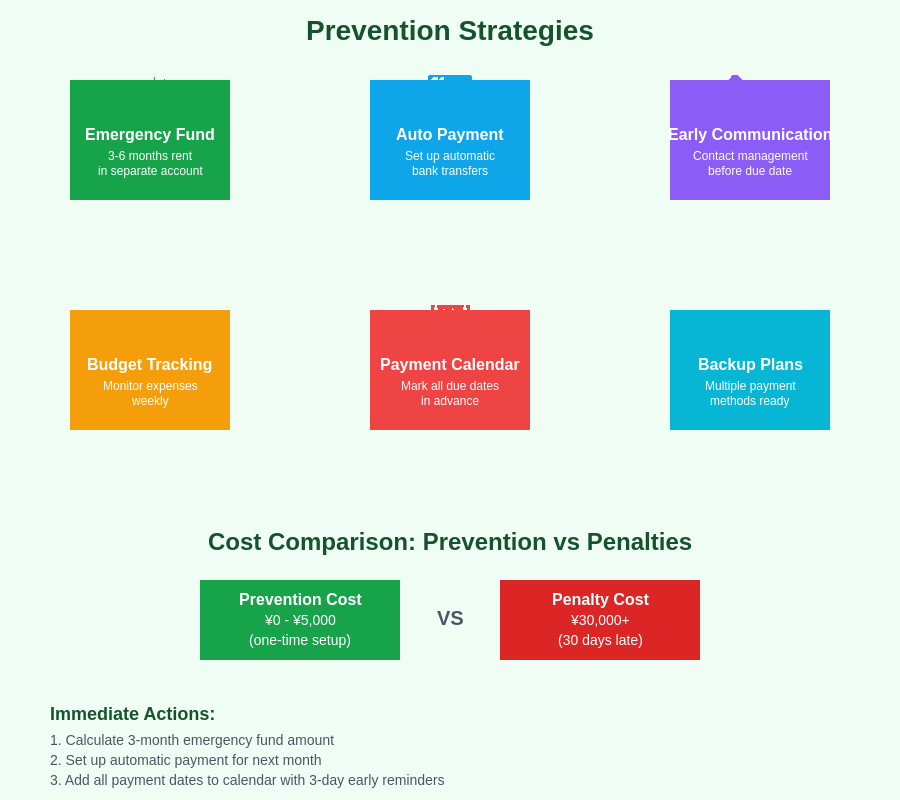
Effective prevention of penalty accumulation requires proactive financial management, clear understanding of contract terms, and immediate communication with property management when payment delays become likely rather than waiting until after payments are already overdue. How to budget realistically for sharehouse living must include emergency fund allocation specifically designed to prevent penalty accumulation during temporary financial difficulties.
Emergency fund maintenance becomes essential for avoiding penalty traps, with financial advisors recommending reserve funds sufficient to cover three to six months of total housing costs including rent, utilities, and potential penalty exposure. This emergency reserve should remain completely separate from other savings and should be considered untouchable except for genuine housing payment emergencies that threaten penalty accumulation.
Early communication with property management companies when payment delays become probable can sometimes result in modified payment schedules, temporary grace periods, or alternative arrangements that minimize penalty accumulation while providing time to resolve underlying financial issues. However, these accommodations typically require proactive contact before payment deadlines pass rather than reactive communication after penalties have already begun accumulating.
Payment scheduling systems and automatic bank transfers can eliminate the risk of accidental late payments due to forgetfulness, travel schedules, or administrative oversight, though these systems require sufficient account balances and careful monitoring to prevent overdraft fees that create additional financial complications. Understanding utility bills in Japanese sharehouses includes recommendations for automated payment systems that reduce late payment risks.
Negotiation Tactics and Damage Limitation
Once penalty accumulation has begun, strategic negotiation with property management companies can sometimes limit ongoing damage and establish manageable repayment schedules that prevent further penalty growth while addressing accumulated debt in reasonable installments. Japanese sharehouse rules every foreigner should know includes cultural considerations that can improve negotiation success rates when addressing financial difficulties with Japanese management companies.
Immediate full payment of accumulated balances represents the most effective method for stopping penalty growth, but this approach requires access to sufficient funds that many residents lack when facing financial difficulties. Partial payment strategies can sometimes slow penalty accumulation if payments are applied to principal amounts first, though understanding specific contract terms becomes essential for determining optimal payment application approaches.
Professional mediation services and tenant advocacy organizations sometimes provide assistance with sharehouse payment disputes and penalty negotiations, particularly when contract terms appear unreasonable or when penalty calculation methods seem inconsistent with standard industry practices. These services can be especially valuable for international residents who face language barriers and cultural differences when attempting to negotiate with Japanese property management companies.
Legal consultation becomes necessary when penalty amounts reach levels that seem disproportionate to the original debt or when contract terms appear to violate consumer protection regulations. However, legal intervention typically represents a last resort option that should be pursued only after other negotiation methods have failed, as legal proceedings can create additional costs and may damage relationships with property management companies that could affect future housing applications.
Long-Term Financial Recovery Planning
Recovery from significant penalty accumulation requires comprehensive financial planning that addresses both immediate debt resolution and long-term prevention of similar situations while rebuilding damaged credit and rental history records. How to actually get your deposit back becomes more challenging when penalty debt affects final account settlements and deposit return calculations.
Debt consolidation strategies might provide lower-interest alternatives to ongoing penalty accumulation, particularly when penalty rates exceed those available through personal loans or credit card advances. However, debt consolidation requires careful analysis of total costs and repayment terms to ensure that consolidation actually reduces overall financial burden rather than simply transferring debt between different creditors with varying terms.
Credit rebuilding efforts must address both the immediate penalty debt and the underlying financial management issues that created the initial payment difficulties. This typically requires comprehensive budget restructuring, emergency fund development, and potentially additional income generation to ensure that future payment obligations can be met consistently without risking additional penalty accumulation.
Alternative housing planning becomes necessary when penalty accumulation makes continued residence financially unsustainable or when eviction proceedings make relocation inevitable. Best Tokyo neighborhoods for sharehouse living requires modification when rental history damage limits available options and forces consideration of less desirable properties or alternative housing arrangements that accommodate damaged credit and rental references.
The devastating financial impact of compounding late payment penalties in Tokyo sharehouses serves as a critical reminder that housing payment obligations must receive absolute priority in personal financial management, as the consequences of payment delays extend far beyond simple inconvenience and can create lasting damage to financial stability and housing security that takes years to fully resolve.
Disclaimer
This article is for informational purposes only and does not constitute legal or financial advice. Late payment penalty structures vary significantly between different sharehouse operators and management companies. Readers should carefully review their specific rental agreements and consult with relevant professionals when facing payment difficulties. The examples provided are illustrative and actual penalty calculations may differ based on specific contract terms and operator policies.