Living in Tokyo sharehouses presents a complex financial balancing act where transportation costs can dramatically reshape your entertainment budget and social opportunities. The intricate relationship between where you live, how you travel, and what you can afford to do for fun creates a cascade of decisions that ultimately define your quality of life in Japan’s capital city. Understanding this dynamic becomes essential for international residents who want to maximize their Tokyo experience while maintaining financial stability throughout their stay.
The geography of Tokyo’s entertainment districts, combined with the city’s extensive but expensive transportation network, means that every social decision carries hidden costs that extend far beyond the price of admission to venues or activities. These transportation expenses often represent the difference between an active, engaging social life and reluctant isolation within your immediate neighborhood, making location strategy one of the most critical factors in sharehouse selection and lifestyle planning.
The Hidden Economics of Tokyo Entertainment
Tokyo’s entertainment landscape operates on a unique economic model where transportation costs function as an invisible tax on social activities, often doubling or tripling the actual cost of evening entertainment through train fares, late-night taxi expenses, and the premium pricing that comes with accessing popular districts during peak hours. This hidden layer of expenses catches many international residents off guard, particularly those coming from cities with more affordable or comprehensive public transportation systems.
The psychological impact of high transportation costs extends beyond simple budget calculations, influencing spontaneous social decisions and gradually reshaping behavior patterns toward more local, predictable activities that require minimal travel investment. How commute times impact your quality of life explores how these daily travel decisions compound over time to significantly affect overall life satisfaction and social integration opportunities.
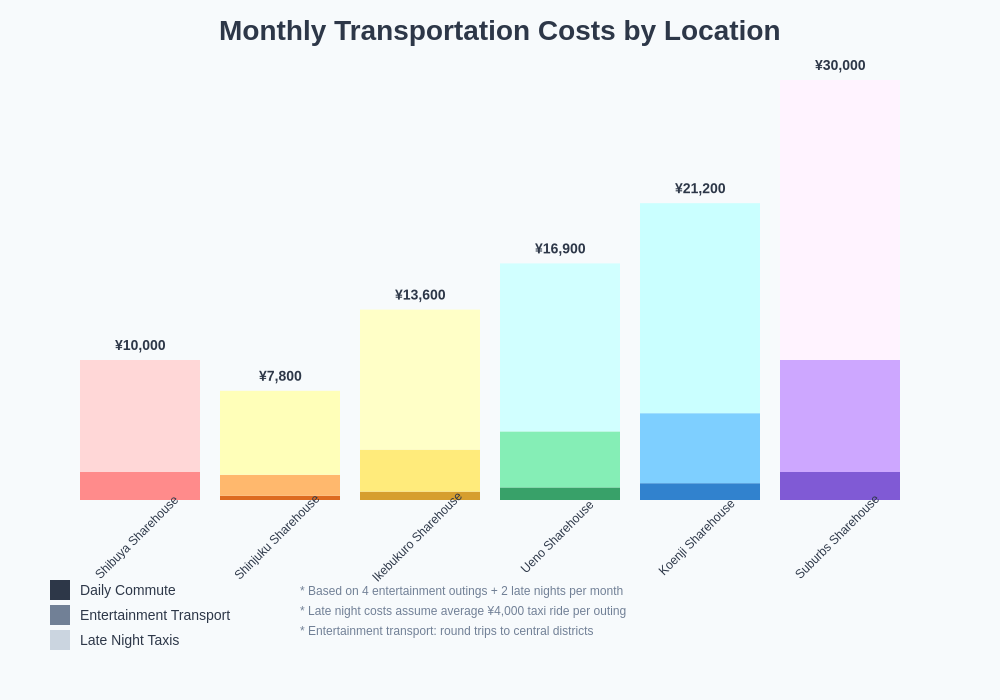
Entertainment districts like Shibuya, Roppongi, and Shinjuku command premium transportation costs due to their central locations and late-night accessibility challenges, creating a tiered system where your geographic proximity to these areas directly correlates with your effective entertainment budget. The farther you live from major entertainment hubs, the more each social outing requires significant transportation investment that can quickly consume discretionary spending allocated for actual entertainment activities.
Strategic Location Selection and Entertainment Access
The choice of sharehouse location represents perhaps the most significant factor in determining long-term entertainment budget sustainability, with residents in central locations enjoying dramatically lower per-activity transportation costs compared to those in suburban or distant neighborhoods. Best Tokyo neighborhoods for sharehouse living provides insights into how neighborhood selection affects not just monthly rent but also ongoing lifestyle costs that accumulate over extended residence periods.
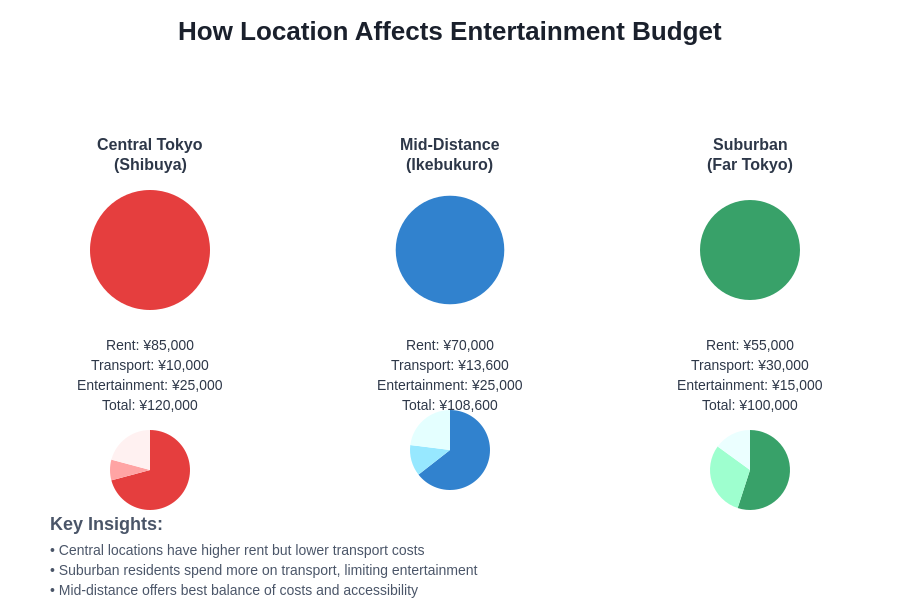
Central Tokyo sharehouses typically command higher monthly rents but offer substantial savings in transportation costs that can offset the premium pricing through reduced need for expensive cross-city travel to access entertainment venues, restaurants, and cultural activities. The mathematical relationship between rent savings in distant locations versus transportation costs for social activities often favors central locations when calculated over monthly or annual periods, particularly for residents who maintain active social lives.
Suburban sharehouse residents frequently find themselves trapped in a cycle where high transportation costs to reach entertainment districts discourage frequent social activities, leading to social isolation that ironically makes the original rent savings meaningless if the goal was to experience Tokyo’s vibrant cultural and social scene. This dynamic creates a false economy where apparent savings in accommodation costs result in significantly higher per-activity entertainment expenses that limit overall experience quality.
The proximity to multiple train lines and transportation options becomes crucial for entertainment budget management, as areas served by single lines or limited connectivity options can create transportation bottlenecks that increase both time and cost for accessing diverse entertainment opportunities throughout the city.
Late-Night Transportation Challenges and Budget Impact
Tokyo’s infamous last train schedules create a particularly expensive challenge for entertainment budgets, as social activities that extend past midnight often require expensive taxi rides that can cost more than the entire evening’s planned entertainment expenses. Late-night transportation limits social life examines how these temporal constraints force budget compromises that significantly impact social participation and cultural experience opportunities.
The psychological pressure of last train deadlines influences entertainment choices in subtle but profound ways, often cutting short enjoyable experiences or forcing expensive alternative transportation decisions that strain monthly budgets. Weekend entertainment becomes particularly costly when late-night taxi rides from central entertainment districts to distant sharehouse locations can easily exceed ¥5,000-8,000, effectively doubling the cost of any social outing that extends past public transportation hours.
Strategic planning around transportation schedules becomes a necessary skill for budget-conscious residents, requiring careful coordination of entertainment timing with train schedules and the acceptance that spontaneous late-night activities carry premium costs that must be budgeted separately from regular entertainment expenses. The development of social networks that include residents from various Tokyo neighborhoods can help create cost-sharing opportunities for late-night transportation through group taxi arrangements or strategic location choices for social gatherings.
Monthly Transportation Passes and Entertainment Strategy
The investment in monthly transportation passes represents a significant upfront cost that can either enhance or constrain entertainment budgets depending on usage patterns and strategic planning around pass benefits and limitations. Understanding the various pass options and their relationship to entertainment access becomes crucial for optimizing both transportation and social spending throughout each month.
Unlimited monthly passes like the Tokyo Metro 24-hour ticket or JR Yamanote Line passes can transform entertainment economics by converting variable transportation costs into fixed monthly expenses, enabling more spontaneous social decisions without the psychological barrier of per-trip cost calculations. However, these passes require sufficient usage to justify their cost, meaning residents must maintain active social lives to achieve break-even points that make the investment worthwhile.
How to calculate your true living costs provides frameworks for evaluating transportation pass investments against actual usage patterns and entertainment goals. The challenge lies in accurately predicting social activity levels while accounting for seasonal variations, work schedule changes, and the natural evolution of social habits that occur during extended residence periods.
Strategic pass selection requires understanding not only your current transportation needs but also aspirational entertainment goals that may justify higher-tier passes that open access to previously cost-prohibitive areas and activities throughout Tokyo’s diverse entertainment landscape.
Group Entertainment Economics and Cost Sharing
Living in sharehouses creates unique opportunities for group entertainment strategies that can dramatically reduce individual transportation costs through coordinated planning and shared expense arrangements. Making friends through Tokyo sharehouse communities explores how these social connections can evolve into practical cost-sharing arrangements that benefit everyone’s entertainment budgets.
Group transportation arrangements, whether through shared taxi costs for late-night returns or coordinated departure times for events in distant locations, can reduce individual transportation expenses by 50-75% while simultaneously enhancing social bonding and creating more engaging entertainment experiences. The key lies in developing house cultures that prioritize group activities and shared planning rather than individual entertainment decisions.
Sharehouse-based entertainment groups often develop sophisticated rotation systems for hosting activities, transportation coordination, and cost-sharing that create sustainable models for active social lives without excessive individual financial burden. These arrangements require clear communication, fair cost distribution, and flexibility to accommodate varying individual budgets and preferences while maintaining group cohesion.
The economics of group entertainment planning extend beyond simple cost division to include strategic venue selection, timing optimization, and the development of entertainment routines that maximize value while minimizing transportation overhead for all participants.
Seasonal Variations and Budget Planning
Tokyo’s distinct seasons create dramatic variations in both transportation comfort and entertainment options that require flexible budget planning to accommodate changing costs and opportunities throughout the year. Summer heat and winter cold affect transportation choices, while seasonal festivals and events create both opportunities and additional expenses that must be integrated into annual entertainment budget planning.
Golden Week, summer festivals, and year-end celebrations represent peak entertainment periods when transportation costs often increase due to higher demand and premium pricing, requiring advance budget allocation to participate fully in these culturally significant events. Why golden week creates housing market changes touches on how these seasonal patterns affect broader living costs beyond just entertainment.
Winter months often see increased transportation costs due to reduced bicycle usage and greater reliance on heated train cars, while summer may require additional transportation budget allocation for air-conditioned venues and increased beverage consumption during travel. Understanding these seasonal patterns enables more accurate annual budget planning and prevents entertainment budget shortfalls during expensive peak periods.
The development of seasonal entertainment strategies, such as focusing on outdoor activities during pleasant weather months and indoor cultural activities during harsh weather periods, can help balance transportation costs while maintaining year-round social engagement and cultural participation.
Technology and Transportation Optimization
Modern smartphone applications and digital tools provide unprecedented opportunities for transportation cost optimization that can significantly improve entertainment budget efficiency through real-time route planning, cost comparison, and group coordination features. Understanding and leveraging these technological solutions becomes essential for maximizing entertainment value while minimizing transportation overhead.
Route optimization apps can identify the most cost-effective transportation combinations for reaching entertainment destinations, often revealing alternative routes that reduce costs by 20-30% compared to obvious direct routes. These tools become particularly valuable for reaching destinations that require multiple train line transfers or comparing train versus bus options for specific journeys.
Group coordination apps enable sharehouse residents to efficiently plan shared transportation arrangements, split costs fairly, and coordinate timing for maximum efficiency and cost savings. How transportation apps change navigation habits examines how these digital tools reshape daily transportation decisions and long-term location strategies.
Real-time transportation monitoring allows for dynamic entertainment planning that takes advantage of service disruptions, special promotions, and optimal timing windows that can reduce transportation costs while improving overall experience quality.
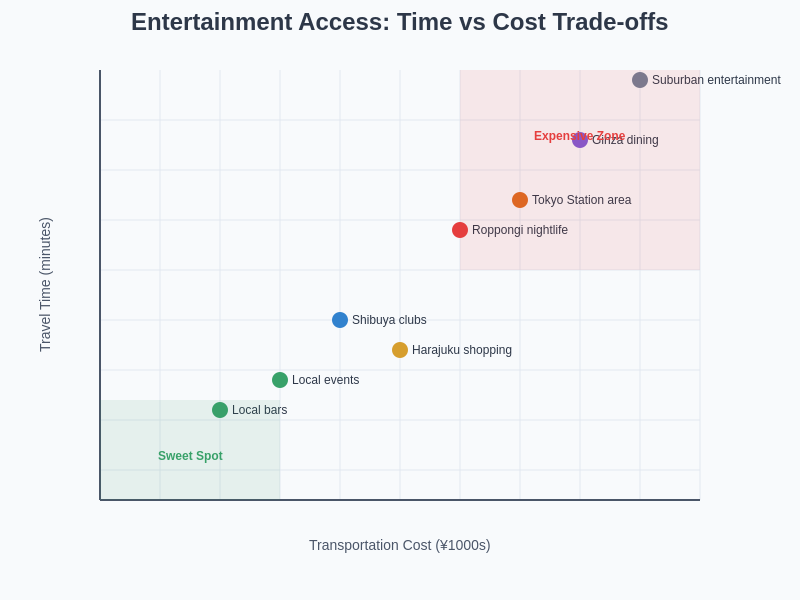
This analysis reveals the sweet spot where entertainment venues offer optimal accessibility without excessive time or cost investment, helping residents make informed decisions about social activities based on their location and budget constraints.
Alternative Transportation Methods and Budget Impact
Beyond Tokyo’s extensive train network, alternative transportation methods such as bicycles, buses, and walking create opportunities for significant entertainment budget optimization when strategically integrated into social planning and sharehouse selection decisions. Understanding the practical applications and limitations of these alternatives enables more flexible and cost-effective approaches to accessing entertainment throughout the city.
Bicycle transportation, while limited by distance and weather considerations, can eliminate transportation costs for local entertainment while providing health benefits and increased spontaneity for social activities within cycling range. How bicycle ownership affects daily routines explores how this transportation choice influences broader lifestyle patterns and entertainment accessibility.
Bus transportation often provides more affordable alternatives to train travel for specific routes, particularly for reaching entertainment destinations not well-served by rail connections. However, longer travel times and less predictable schedules require different planning approaches that may not suit all entertainment activities or timing requirements.
Strategic walking as entertainment transportation becomes viable for residents in central locations, where 20-30 minute walks can access diverse entertainment districts while providing additional health benefits and opportunities for discovering new venues and experiences along the route.
Long-term Financial Planning and Entertainment Sustainability
Sustainable entertainment budgets require long-term perspective that accounts for changing circumstances, evolving social needs, and the natural progression of Tokyo residence experience that affects both transportation patterns and entertainment preferences over time. How to budget realistically for sharehouse living provides frameworks for integrating entertainment and transportation costs into comprehensive financial planning.
The relationship between transportation costs and entertainment spending evolves as residents develop local social networks, discover neighborhood entertainment options, and refine their understanding of Tokyo’s diverse cultural landscape. Initial periods of high transportation costs for exploration often give way to more efficient patterns based on established preferences and social connections.
Career development and income changes throughout Tokyo residence require periodic reevaluation of the balance between accommodation location, transportation costs, and entertainment budget allocation to ensure continued alignment with personal goals and financial capabilities. The flexibility to adjust these relationships becomes crucial for maintaining long-term satisfaction and financial stability.
Understanding entertainment budget sustainability involves recognizing that transportation costs represent an investment in cultural experience, social integration, and personal development that contributes to overall residence quality and long-term satisfaction with the Tokyo living experience.
The interplay between transportation costs and entertainment budgets ultimately reflects broader life choices about priorities, social engagement, and cultural participation that define the quality and meaning of international residence in Tokyo. Strategic planning, technological optimization, and community collaboration can help maximize entertainment value while maintaining financial responsibility throughout your sharehouse living experience.
Disclaimer
This article is for informational purposes only and does not constitute professional financial advice. Transportation costs and entertainment expenses in Tokyo vary significantly based on individual circumstances, usage patterns, and seasonal factors. Readers should conduct their own research and consider their specific financial situation when making budgeting decisions. Prices and transportation options mentioned may change, and actual costs may differ from estimates provided.