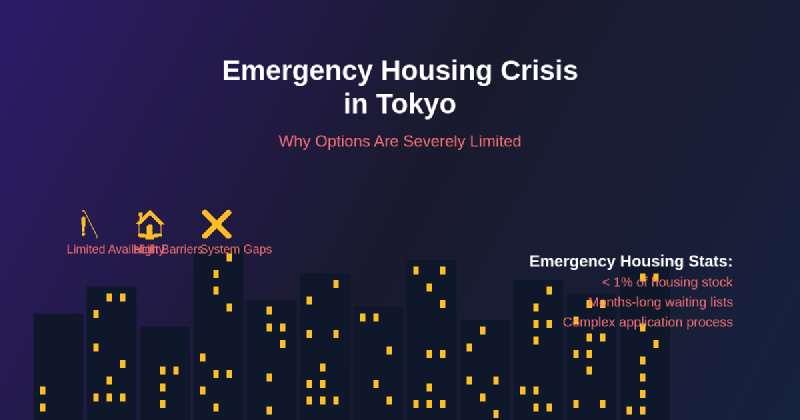
Tokyo’s emergency housing shortage represents one of the most pressing challenges facing both residents and newcomers to Japan’s capital city. The limited availability of immediate accommodation options creates significant stress and financial burden for individuals experiencing unexpected housing crises, whether due to natural disasters, job loss, relationship breakdowns, or sudden lease terminations. Understanding the complex web of factors that contribute to this limitation reveals deeper structural issues within Tokyo’s housing market and social support systems.
The scarcity of emergency housing options extends beyond simple supply and demand economics, encompassing regulatory barriers, cultural attitudes, bureaucratic inefficiencies, and systemic discrimination that collectively create an environment where those in desperate need of immediate shelter often find themselves with few viable alternatives. This crisis affects not only the most vulnerable populations but also middle-class residents who suddenly find themselves without housing due to circumstances beyond their control.
Structural Barriers in Tokyo’s Housing Market
Tokyo’s housing market operates under a complex system of regulations, customs, and business practices that inherently limit flexibility and rapid accommodation provision. The traditional rental process requires extensive documentation, guarantor arrangements, and advance payments that can total several months of rent, making it nearly impossible for individuals in emergency situations to secure housing quickly. Understanding how to find the perfect sharehouse in Tokyo reveals just how complex even standard housing searches can become.
The rigid application procedures demanded by most landlords and real estate agencies create significant barriers for anyone who cannot provide complete documentation, stable employment verification, or local guarantor support. These requirements, while designed to protect property owners from financial risk, effectively exclude individuals experiencing housing emergencies who may have lost their jobs, ended relationships with guarantors, or face other circumstances that compromise their ability to meet standard application criteria.
Property management companies and landlords typically prefer tenants who demonstrate long-term stability and predictable income patterns, making them reluctant to accommodate emergency housing requests that might indicate underlying instability or financial distress. This risk-averse approach, while understandable from a business perspective, contributes to the systematic exclusion of emergency housing seekers from the mainstream rental market.
Government Support System Inadequacies
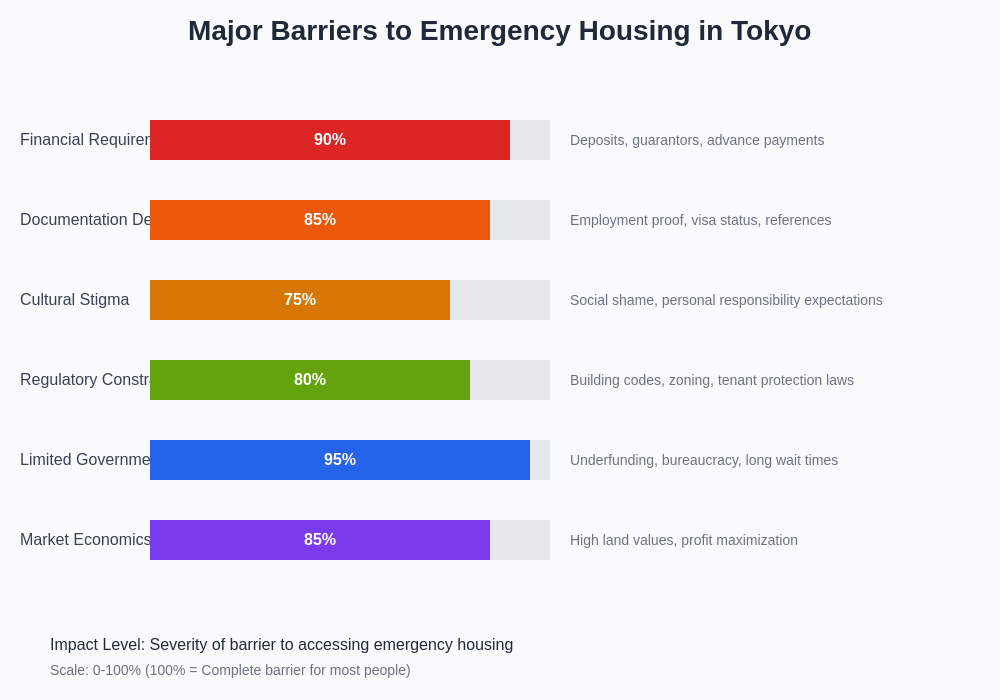
Tokyo’s municipal and prefectural government emergency housing programs suffer from chronic underfunding, limited capacity, and bureaucratic processes that prevent rapid response to housing crises. The existing public housing options primarily serve long-term residents rather than providing immediate emergency accommodation, with waiting lists that can extend for months or years rather than addressing urgent needs within days or weeks.
The application processes for government-assisted housing typically require extensive documentation, income verification, and residency requirements that many emergency housing seekers cannot fulfill quickly enough to address their immediate needs. Living costs in Tokyo sharehouses explained demonstrates how even understanding basic housing costs can be challenging, let alone navigating emergency assistance programs.
Social welfare departments often lack the resources and authority to provide immediate temporary accommodation, instead focusing on longer-term housing solutions that require extensive evaluation and approval processes. This gap between immediate need and available government support leaves many individuals without viable options during critical periods when rapid housing placement could prevent homelessness or more severe social problems.
The coordination between different government agencies responsible for emergency services, social welfare, and housing policy often proves inadequate for addressing housing crises that require immediate action and flexible response capabilities. Bureaucratic silos and jurisdictional limitations prevent comprehensive emergency housing responses that could address the full scope of individual needs during housing crises.
Cultural and Social Factors
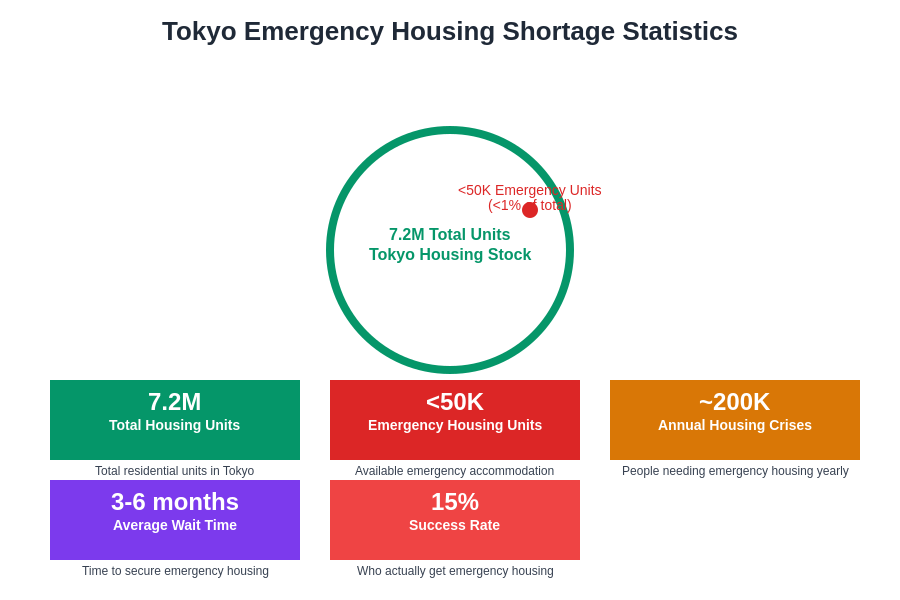
Japanese society’s emphasis on personal responsibility and family support networks creates cultural expectations that individuals should resolve housing problems through private means rather than seeking public assistance or emergency accommodation. This cultural framework contributes to limited public support for emergency housing programs and reduces political pressure for expanding such services.
The stigma associated with housing instability and homelessness in Japanese society discourages both public discussion of emergency housing needs and private sector involvement in providing temporary accommodation solutions. Making friends through Tokyo sharehouse communities highlights how social connections are crucial, yet the social shame around housing crises often prevents people from seeking help from these networks.
Traditional Japanese employment and housing patterns assume long-term stability and gradual career progression, making the social safety net less equipped to handle sudden disruptions that require immediate housing solutions. The expectation that individuals will maintain stable housing through careful planning and conservative life choices creates blind spots in support systems for those experiencing unexpected crises.
Cultural attitudes toward temporary or transitional housing often view such arrangements as inherently unstable or undesirable, reducing both the supply of emergency accommodation and the social acceptance of individuals who require such services. This cultural bias affects everything from landlord willingness to provide short-term rentals to employer attitudes toward employees experiencing housing instability.
Economic Pressures and Market Dynamics
Tokyo’s extremely high land values and construction costs make it economically unfeasible for most organizations to maintain emergency housing facilities that remain vacant until needed. The opportunity cost of dedicating valuable Tokyo real estate to emergency housing rather than more profitable uses creates strong economic incentives against maintaining adequate emergency accommodation capacity.
The private sector’s focus on maximizing rental income through long-term leases with stable tenants reduces the availability of properties suitable for emergency housing arrangements. Property owners generally prefer predictable rental income over the uncertainty and potential complications associated with emergency housing placements. How much Tokyo sharehouses really cost per month illustrates how expensive even basic housing has become in Tokyo.
Financial institutions and insurance companies typically discourage landlords from engaging in emergency housing arrangements due to perceived increased risks of property damage, rent default, and legal complications. These institutional pressures create additional barriers to emergency housing provision even when individual property owners might be willing to help.
The lack of government subsidies or financial incentives for private sector emergency housing provision means that such services must operate at market rates, making them unaffordable for many individuals experiencing housing crises who have simultaneously lost income or face unexpected expenses.
Legal and Regulatory Constraints
Japan’s tenant protection laws, while beneficial for long-term renters, create complexities for emergency housing arrangements that discourage property owners from providing short-term accommodation. The difficulty of removing tenants who overstay emergency arrangements or fail to transition to permanent housing creates legal risks that many landlords prefer to avoid entirely.
Building codes and safety regulations designed for permanent residential use may not accommodate the flexible arrangements necessary for emergency housing, creating compliance challenges for organizations attempting to provide temporary accommodation. Japanese sharehouse rules every foreigner should know shows how complex housing regulations can be even in standard situations.
Zoning restrictions limit the types of properties that can legally provide temporary accommodation, reducing the pool of potential emergency housing locations and increasing costs for compliant facilities. These regulations, intended to maintain neighborhood character and safety, inadvertently contribute to emergency housing scarcity by limiting operational flexibility.
Fire safety and emergency evacuation requirements for temporary accommodation facilities often exceed those for permanent housing, creating additional compliance costs and operational complexity that discourage emergency housing provision. The bureaucratic process for obtaining permits and approvals for emergency housing operations can take months or years, preventing rapid response to emerging housing crisis needs.
International Resident Challenges
Foreign residents in Tokyo face additional barriers to emergency housing due to language requirements, cultural unfamiliarity, and discrimination that compounds the general shortage of emergency accommodation options. Many emergency services operate only in Japanese, creating communication barriers that prevent effective access to available resources during crisis situations.
Visa status and immigration concerns add complexity to emergency housing situations for international residents, as temporary accommodation providers may be reluctant to accept tenants whose legal status might affect their ability to maintain housing arrangements. English-speaking sharehouses in Tokyo for foreigners highlights how language barriers affect even standard housing searches.
The lack of family and social support networks that typically provide emergency accommodation for Japanese residents leaves international residents more dependent on formal emergency housing services that are already inadequate for the general population. Cultural differences in crisis response and help-seeking behavior may prevent international residents from effectively accessing available emergency housing resources.
Discrimination against foreign residents in housing markets extends to emergency accommodation, with some providers explicitly or implicitly excluding international residents from emergency housing programs due to perceived communication difficulties, cultural differences, or administrative complications.
Alternative Accommodation Limitations
Tokyo’s hotel and hospitality industry, while extensive, operates at capacity levels that provide little emergency accommodation availability during peak periods, and the costs of extended hotel stays quickly become prohibitive for most individuals experiencing housing crises. The tourism-focused nature of much of Tokyo’s temporary accommodation makes it unsuitable for emergency housing needs that require longer-term stability.
Internet cafes, capsule hotels, and other unconventional accommodation options that sometimes serve as emergency housing lack the amenities, privacy, and security necessary for addressing serious housing crises. These facilities typically impose time limits and usage restrictions that prevent them from serving as viable temporary housing solutions for extended periods.
The sharing economy and short-term rental platforms face regulatory restrictions and high costs that limit their availability for emergency housing purposes. Best Tokyo neighborhoods for sharehouse living shows how even finding regular shared accommodation can be challenging, let alone emergency options.
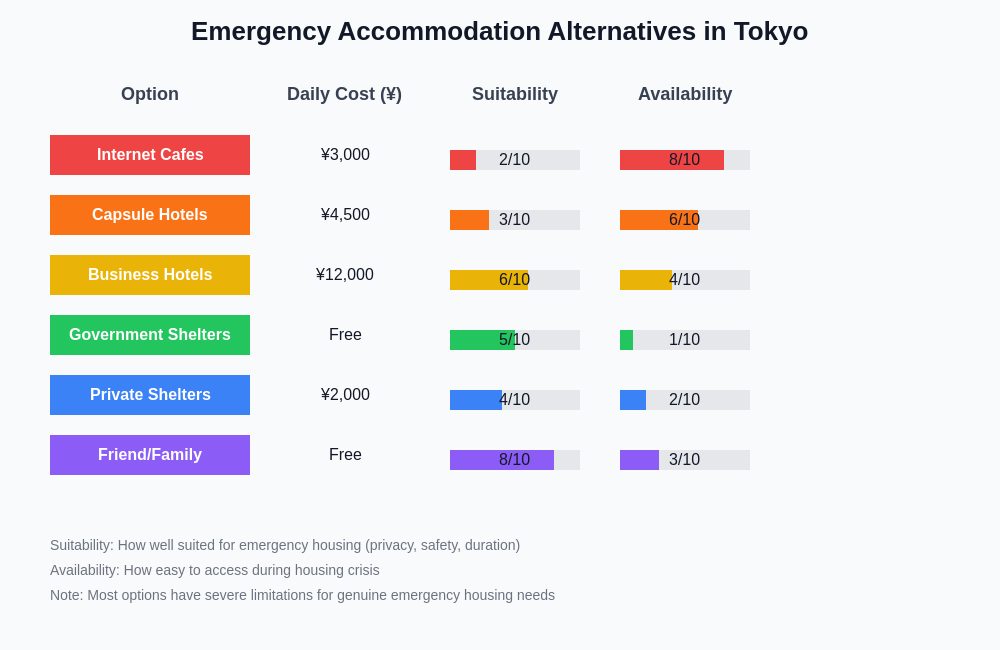
Corporate housing and serviced apartment facilities generally require advance booking and corporate guarantees that exclude individual emergency housing seekers, despite having the infrastructure that could potentially accommodate emergency housing needs.
Impact on Vulnerable Populations
The emergency housing shortage disproportionately affects elderly residents, individuals with disabilities, single mothers, and other vulnerable populations who face additional barriers in securing alternative accommodation. These groups often have limited financial resources, reduced mobility, and special needs that make them particularly dependent on specialized emergency housing services that are inadequately provided in Tokyo.
Mental health crises and domestic violence situations often trigger immediate housing needs that cannot be addressed through conventional housing searches, yet Tokyo’s emergency housing system lacks the capacity and specialized services necessary to provide appropriate accommodation for these sensitive situations. How domestic violence incidents affect everyone touches on how these crises impact entire communities.
Youth aging out of institutional care or family support face particular challenges in accessing emergency housing due to their limited credit history, employment stability, and social connections. The transition to independent living becomes especially precarious when emergency housing options are unavailable to bridge gaps between institutional support and permanent housing arrangements.
Individuals experiencing job loss, medical emergencies, or family crises that simultaneously affect income and housing stability find themselves caught in a cycle where emergency housing scarcity prevents them from maintaining the stability necessary to address their underlying problems and return to stable housing situations.
Seasonal and Disaster-Related Pressures
Tokyo’s emergency housing shortage becomes acute during natural disasters, when sudden displacement creates immediate needs for temporary accommodation that far exceed the limited emergency housing capacity. How earthquake drills expose building weaknesses shows how disaster preparedness reveals systemic vulnerabilities.
Seasonal employment patterns and academic calendars create periodic surges in housing demand that reduce the availability of emergency accommodation when economic or personal crises coincide with peak housing market activity. The competition for housing during university enrollment periods and job transition seasons makes emergency housing even more scarce during these critical times.
Climate-related events such as typhoons, flooding, and extreme weather increasingly create emergency housing needs that overwhelm Tokyo’s limited disaster response capacity. The aging infrastructure and dense urban development patterns increase vulnerability to weather-related displacement while emergency housing options remain static.
Winter months present particular challenges for emergency housing as outdoor alternatives become dangerous and demand for heated accommodation increases while supply remains constant. The health and safety risks associated with inadequate emergency accommodation become life-threatening during extreme weather conditions.
Economic Consequences of Limited Options
The lack of emergency housing options creates cascading economic effects that increase the overall cost of housing crises for both individuals and society. How living in sharehouses affects your taxes demonstrates how housing instability can have complex financial implications.
Individuals forced into expensive temporary accommodation alternatives often exhaust their financial resources rapidly, making it more difficult to secure permanent housing and increasing their long-term dependence on social services. The absence of affordable emergency housing options can transform temporary setbacks into long-term homelessness or severe financial distress.
Employers face productivity losses and increased administrative burden when employees experience housing crises that affect their ability to work consistently. The lack of emergency housing support can lead to job loss, creating additional economic and social costs that could be prevented through adequate emergency accommodation provision.
Healthcare and social service systems bear increased costs when housing instability leads to mental health crises, family breakdown, and other social problems that require expensive interventions. The prevention potential of adequate emergency housing represents significant cost savings compared to addressing the consequences of housing crises through other social services.
Technology and Innovation Gaps
Tokyo’s emergency housing system lacks the technological infrastructure necessary for rapid matching of available accommodation with individuals in crisis, resulting in inefficient allocation of scarce emergency housing resources. Digital platforms that could streamline emergency housing placement remain underdeveloped compared to commercial housing search technologies.
Information systems for tracking emergency housing availability, coordinating between service providers, and managing emergency housing placements operate with outdated technology that prevents efficient response to housing crises. The lack of real-time data on emergency housing availability means that individuals in crisis cannot quickly identify and access available options.
Communication technologies that could connect emergency housing seekers with potential providers, volunteers, or support services remain fragmented and difficult to access during crisis situations when rapid response is crucial. Social media and mobile applications could facilitate emergency housing coordination but lack the institutional support and integration necessary for effective crisis response.
Predictive analytics and data-driven approaches that could help anticipate emergency housing needs and optimize resource allocation are not systematically employed in Tokyo’s emergency housing planning, resulting in reactive rather than proactive emergency housing provision.
The combination of structural, economic, cultural, and regulatory factors that limit emergency housing options in Tokyo creates a complex challenge that requires comprehensive reform rather than incremental improvements. Understanding these limitations helps explain why individuals experiencing housing crises often find themselves with few viable options and highlights the need for systematic changes to address this critical urban challenge. The human cost of inadequate emergency housing extends far beyond temporary inconvenience, affecting long-term stability, mental health, and social cohesion in ways that impact the entire Tokyo metropolitan community.
Disclaimer
This article is for informational purposes only and does not constitute professional advice regarding housing or legal matters. Emergency housing availability and regulations may change, and specific circumstances may affect individual options. Readers facing housing emergencies should consult with relevant government agencies, social services, and legal professionals for current information and assistance tailored to their specific situations.