The morning bathroom queue represents one of the most universally experienced challenges in sharehouse living, transcending cultural boundaries, house rules, and even the most well-intentioned scheduling attempts by residents and management companies alike. This seemingly simple logistical issue reveals deeper mathematical principles, human behavioral patterns, and systemic design limitations that make bathroom congestion not just likely, but mathematically inevitable in virtually every shared living environment with more than three residents.
Understanding why morning bathroom queues persist despite countless attempts at resolution provides valuable insights into the fundamental nature of shared living spaces and helps residents develop more realistic expectations and effective coping strategies. The persistence of this issue across different cultures, house sizes, and management approaches suggests that the problem lies not in poor planning or inconsiderate residents, but in the basic mathematical relationship between human schedules, resource availability, and peak demand periods.
The Mathematical Reality of Peak Demand
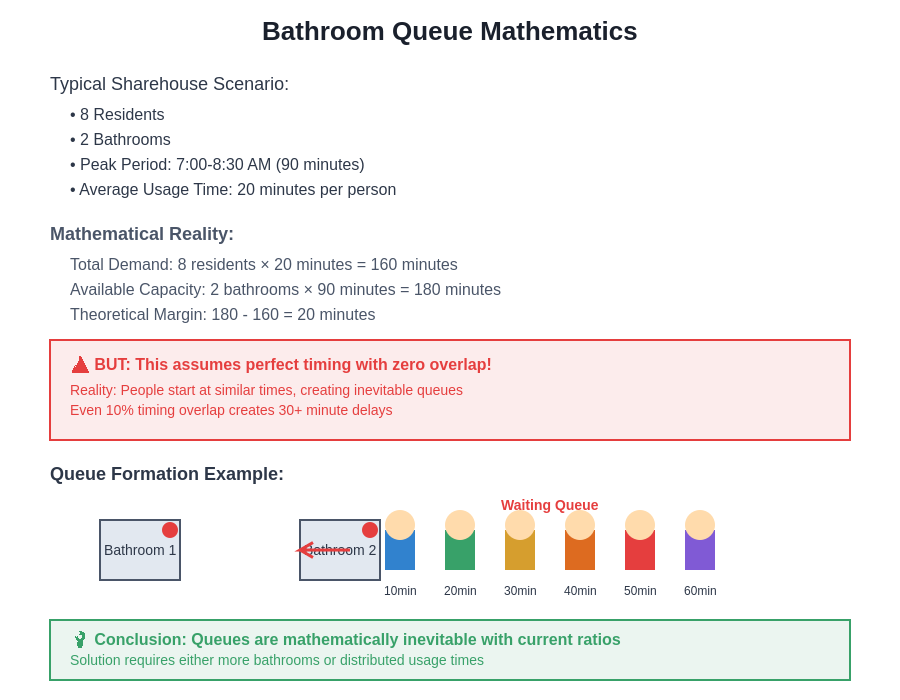
The formation of morning bathroom queues in sharehouses follows predictable mathematical principles that govern resource allocation during peak demand periods. When multiple individuals require access to limited facilities within compressed time windows, bottlenecks become not just possible but statistically certain, regardless of individual intentions or scheduling efforts.
Understanding how commute times impact work performance reveals why most residents cannot simply adjust their morning schedules significantly later, as work and school commitments create inflexible departure times that compress bathroom usage into narrow windows. The typical sharehouse resident requires approximately fifteen to twenty-five minutes for complete morning bathroom routines, including showering, personal hygiene, and preparation activities.
When six to eight residents share two bathroom facilities, the mathematical reality becomes clear through simple capacity analysis. Even with perfect coordination and minimal individual usage times, the peak demand period between 6:30 AM and 8:30 AM cannot accommodate all residents without significant queuing or schedule compression that forces individuals to wake substantially earlier than their natural preferences would dictate.
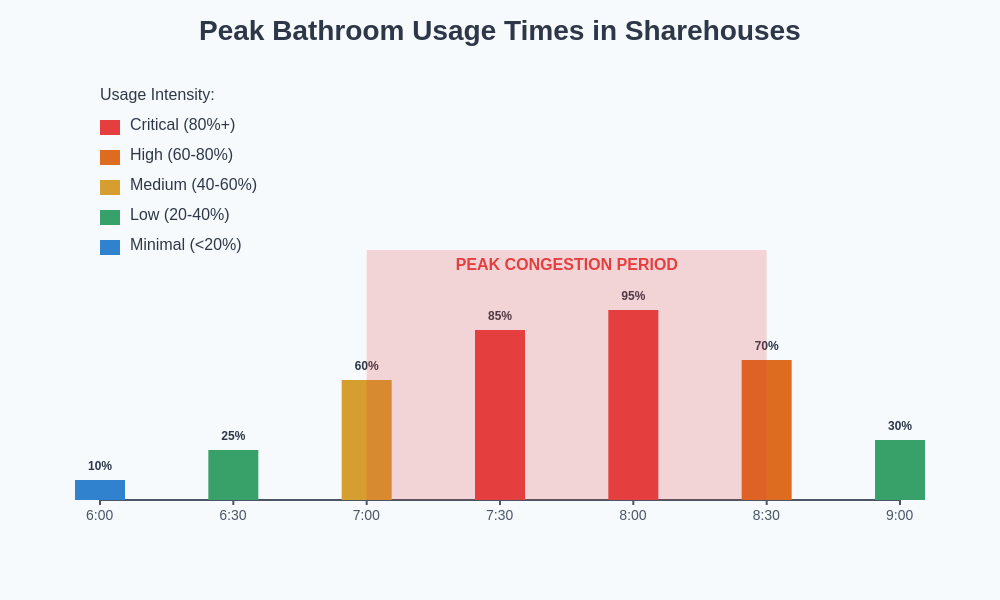
The compounding effect of variable individual schedules creates additional complexity, as slight variations in wake-up times, unexpected delays, or longer-than-usual routines can cascade through the entire morning schedule, creating delays that affect multiple subsequent users and often persist throughout the peak period.
Cultural and Behavioral Factors Amplifying Congestion
Japanese bathroom culture emphasizes thoroughness and cleanliness in ways that significantly extend individual usage times compared to many other cultural approaches to morning routines. Living with Japanese roommates in Tokyo sharehouses highlights how different cultural expectations around bathroom etiquette and cleanliness standards can create longer individual usage periods that exacerbate scheduling conflicts.
The social dynamics of international sharehouses add another layer of complexity, as residents from different cultural backgrounds bring varying expectations about appropriate bathroom usage duration, cleaning responsibilities, and queue etiquette. Some cultures prioritize quick, efficient routines, while others emphasize thorough preparation and self-care practices that naturally require more time and space.
Privacy considerations also influence bathroom usage patterns, as many residents prefer to complete their entire morning routine in the privacy of the bathroom rather than moving between bathroom and bedroom multiple times. This preference for consolidated bathroom time increases individual usage duration and reduces overall facility availability during peak periods.
The psychological factor of queue stress often leads to counterproductive behaviors, where residents either rush through important hygiene routines or, conversely, take longer than necessary due to anxiety about others waiting. How stress management techniques become necessary explores how daily stressors like bathroom queues can accumulate and affect overall living satisfaction.
Architectural and Design Limitations
The fundamental architecture of most Tokyo sharehouses reflects economic optimization rather than peak-period functionality, with bathroom facilities designed to meet minimum regulatory requirements rather than optimal user experience during high-demand periods. Why some buildings lack proper ventilation demonstrates how cost-saving measures in building design often create additional complications that extend individual bathroom usage times.
Standard sharehouse layouts typically feature bathroom-to-resident ratios that work adequately during off-peak hours but become severely inadequate during the concentrated morning rush. The typical ratio of one bathroom per four to six residents assumes evenly distributed usage throughout the day, failing to account for the reality that sixty to seventy percent of daily bathroom usage occurs within a two-hour morning window.
Space constraints in converted residential buildings often prevent the installation of additional facilities or the separation of different bathroom functions that could improve efficiency. Many sharehouses combine showering, toilet facilities, and vanity areas in single rooms, preventing parallel usage and extending the time required for each resident to complete their full morning routine.
Ventilation and humidity control systems in older buildings often require extended operation times between users, particularly during Tokyo’s humid seasons, adding mandatory waiting periods that further reduce effective facility availability during peak demand periods.
The Impossibility of Perfect Scheduling Solutions
Despite countless attempts by residents and management companies to implement bathroom scheduling systems, these solutions consistently fail due to the inherent unpredictability of human schedules and the rigid constraints of external commitments. How shift work schedules affect roommate relations illustrates how varying work schedules create additional complexity that makes comprehensive scheduling nearly impossible.
Schedule-based solutions assume that residents can flexibly adjust their wake-up times and morning routines to fit predetermined slots, but this assumption fails to account for natural circadian rhythms, varying sleep requirements, and external schedule constraints that limit individual flexibility. Most residents cannot simply wake up an hour earlier to avoid peak bathroom times without significant impacts on sleep quality and overall well-being.
The dynamic nature of sharehouse populations, with residents frequently moving in and out, makes maintaining consistent scheduling systems practically impossible. New residents must be integrated into existing schedules, departing residents leave gaps that require reorganization, and temporary schedule changes due to illness, travel, or work variations constantly disrupt established patterns.
Enforcement mechanisms for bathroom schedules typically rely on social pressure and voluntary compliance, creating systems that work well for considerate residents but break down when any individual fails to adhere to agreed-upon times. The social awkwardness of confronting schedule violators often leads to passive acceptance of disruptions that gradually erode the entire scheduling system.
Economic and Space Efficiency Trade-offs
The persistence of bathroom queues reflects fundamental economic trade-offs in sharehouse design and operation, where additional bathroom facilities would require significant space and financial investments that would necessarily increase rental costs for all residents. How much Tokyo sharehouses really cost per month demonstrates how facility improvements directly impact affordability for price-sensitive residents.
Property owners and management companies must balance facility adequacy against rental affordability, often choosing configurations that minimize costs while meeting basic regulatory requirements. Adding additional bathrooms or expanding existing facilities requires substantial renovation investments and reduces the number of rentable rooms, directly impacting property profitability and rental affordability.
The space efficiency calculations that determine sharehouse layouts prioritize maximizing bedroom count over common area functionality, reflecting market demand for affordable private spaces rather than premium shared facilities. This optimization approach creates environments where bedroom space is adequate but common facilities become bottlenecks during peak usage periods.
Alternative solutions such as premium sharehouses with superior bathroom ratios exist but command rental prices that exclude many international residents, particularly students and entry-level professionals who represent the core sharehouse demographic. Luxury sharehouses worth the extra cost in Tokyo explores how improved facilities correlate with significantly higher costs.
Psychological and Social Adaptation Strategies
Successful long-term sharehouse residents develop psychological adaptation strategies that reduce the stress and frustration associated with inevitable bathroom queues, transforming a daily inconvenience into a manageable aspect of shared living. These adaptation strategies often involve fundamental shifts in expectations and morning routine flexibility rather than attempting to eliminate the queues entirely.
Mental reframing techniques help residents view bathroom queues as opportunities for brief social interaction, meditation time, or morning planning rather than as frustrating delays. This perspective shift reduces stress responses and can actually improve overall morning experiences by creating moments of calm before busy days begin.
Developing backup routines and alternative preparation strategies allows residents to productively use queue time for other morning activities such as preparing breakfast, organizing belongings, or planning daily schedules. How morning routines need complete restructuring discusses how shared living requires fundamental changes to personal routines and expectations.
Social cooperation strategies emerge naturally in well-functioning sharehouses, where residents develop informal communication systems, mutual assistance arrangements, and flexible scheduling approaches that reduce queue-related stress while building community relationships. These organic solutions often prove more effective than formal scheduling systems because they adapt dynamically to changing circumstances and individual needs.
Technological and Innovation Attempts
Various technological solutions have been attempted to address bathroom queue management, from simple scheduling apps to sophisticated occupancy monitoring systems, but these innovations consistently encounter implementation challenges that limit their effectiveness in real-world sharehouse environments.
Digital scheduling platforms designed specifically for sharehouse bathroom management face adoption barriers related to smartphone usage habits, technical literacy variations among international residents, and the overhead required to maintain accurate, real-time scheduling information. How digital contracts are still uncommon reflects broader patterns of slow technology adoption in Japanese housing markets.
Occupancy indicator systems that show bathroom availability in real-time address the uncertainty aspect of queuing but cannot resolve the fundamental capacity limitations during peak demand periods. These systems may reduce anxiety about unknown wait times but do not increase actual facility availability or eliminate the need for queuing during busy periods.
Smart home integration approaches that attempt to coordinate bathroom usage with other morning activities show promise but require significant technical infrastructure investments and resident training that exceed the capabilities and budgets of most sharehouse operations. The complexity of integrating multiple systems often creates new problems while failing to address underlying capacity constraints.
Long-term Industry Trends and Future Outlook
The sharehouse industry’s response to bathroom queue challenges reflects broader trends toward premium co-living concepts that prioritize facility adequacy over maximum affordability, potentially changing the fundamental value proposition of shared living in Tokyo. How sharehouse rent pricing works in Japan examines how facility improvements affect pricing structures and market positioning.
Emerging co-living companies are experimenting with innovative bathroom configurations, including pod-style facilities, distributed vanity areas, and flexible-use spaces that can adapt to peak demand periods. These design innovations require significant upfront investments but may address capacity constraints more effectively than traditional approaches.
Market segmentation trends suggest that bathroom adequacy is becoming a more significant factor in sharehouse selection decisions, particularly among professional residents with higher disposable incomes and more demanding lifestyle expectations. This trend may drive facility improvements in premium market segments while maintaining traditional configurations in budget-oriented properties.
Regulatory developments related to housing standards and resident welfare may eventually mandate improved bathroom ratios in shared living facilities, though such changes would likely increase costs and reduce affordability for current sharehouse demographics. The balance between facility standards and affordability remains a central challenge for industry development.
Practical Coping Strategies for Current Residents
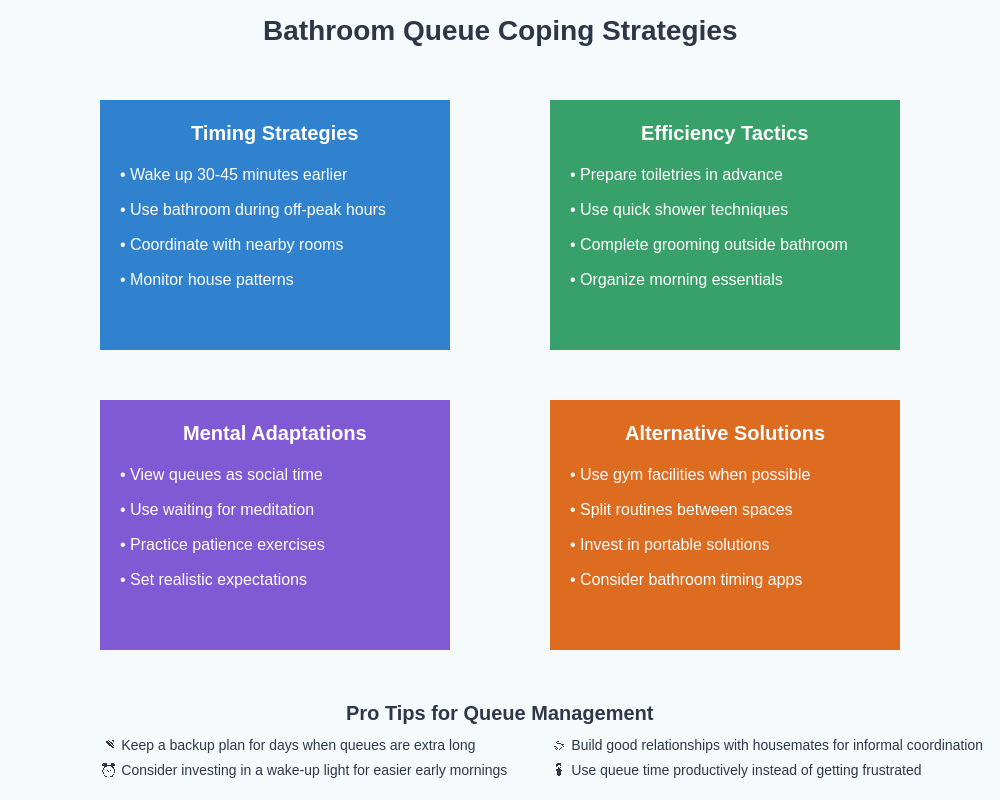
While systemic solutions to bathroom queues remain elusive, individual residents can implement practical strategies that reduce personal stress and improve their daily experience within existing constraints. These approaches focus on adaptation and optimization rather than attempting to eliminate queues entirely.
Flexible morning routine development allows residents to identify activities that can be completed outside the bathroom, reducing total facility usage time and creating more opportunities for efficient scheduling. Preparation activities such as clothing selection, bag packing, and breakfast planning can often be completed while waiting or before bathroom access becomes necessary.
Communication and coordination with immediate neighbors often proves more effective than house-wide scheduling systems, as smaller groups can more easily negotiate flexible arrangements and mutual accommodations. Building positive relationships with adjacent room residents frequently leads to informal cooperation that benefits all parties involved.
Strategic timing adjustments based on observed patterns can help residents identify slightly less congested periods within the general peak demand window. Small shifts in timing, such as moving thirty minutes earlier or later, sometimes provide significantly improved access while maintaining compatibility with external schedule requirements.
The reality of morning bathroom queues in sharehouses represents a fascinating intersection of mathematics, human behavior, economics, and social dynamics that demonstrates how seemingly simple problems can resist straightforward solutions. Understanding these underlying factors helps residents develop realistic expectations and effective coping strategies while appreciating the complex trade-offs that make shared living both challenging and affordable.
Rather than viewing bathroom queues as failures of planning or consideration, recognizing them as inevitable consequences of resource optimization in shared living environments allows residents to focus on adaptation and community building rather than frustration and conflict. How to handle roommate conflicts without moving out provides additional strategies for managing the interpersonal challenges that can arise from daily inconveniences like bathroom access.
The persistence of this challenge across cultures, house types, and management approaches suggests that successful sharehouse living requires embracing certain inconveniences as trade-offs for the benefits of affordable, community-oriented housing in one of the world’s most expensive cities. Developing patience, flexibility, and creative problem-solving skills around daily logistics like bathroom access often translates into improved life skills that benefit residents long after their sharehouse experience ends.
Disclaimer
This article is for informational purposes only and reflects general observations about sharehouse living patterns. Individual experiences may vary significantly based on specific house layouts, resident numbers, and community dynamics. The strategies mentioned should be adapted to individual circumstances and house rules. Readers experiencing persistent conflicts related to bathroom access should communicate with house management and fellow residents to develop appropriate solutions for their specific situations.