Living in Tokyo sharehouses creates an unexpected phenomenon where ordinary international residents gradually transform into sophisticated transportation experts, developing an almost encyclopedic knowledge of the city’s complex transit networks, alternative routes, and time-saving strategies that would impress even longtime Tokyo natives. This transformation occurs not through formal study or deliberate effort, but as a natural consequence of the unique living situation that sharehouse residents find themselves navigating daily.
The evolution from confused newcomer to transportation guru represents one of the most practical and valuable skills that sharehouse living inadvertently cultivates. Unlike tourists who follow predetermined routes or locals who stick to familiar patterns, sharehouse residents face constant transportation challenges that force them to explore, experiment, and master the intricate web of Tokyo’s public transit system in ways that few other living situations demand.
The Daily Navigation Challenge
Tokyo’s transportation network encompasses an overwhelming array of train lines, subway systems, bus routes, and connection points that create millions of possible route combinations for any given journey. Sharehouse residents face this complexity multiplied by the diverse destinations their daily lives require, from work locations scattered across different business districts to social activities in various entertainment zones, shopping expeditions to specialized districts, and visits to friends living in completely different areas of the metropolitan region.
Understanding how commute times impact your quality of life becomes essential knowledge that sharehouse residents develop through daily experience rather than theoretical study. The constant need to optimize travel time, minimize costs, and avoid peak-hour crowding creates a practical education in transportation efficiency that transforms casual users into strategic route planners.
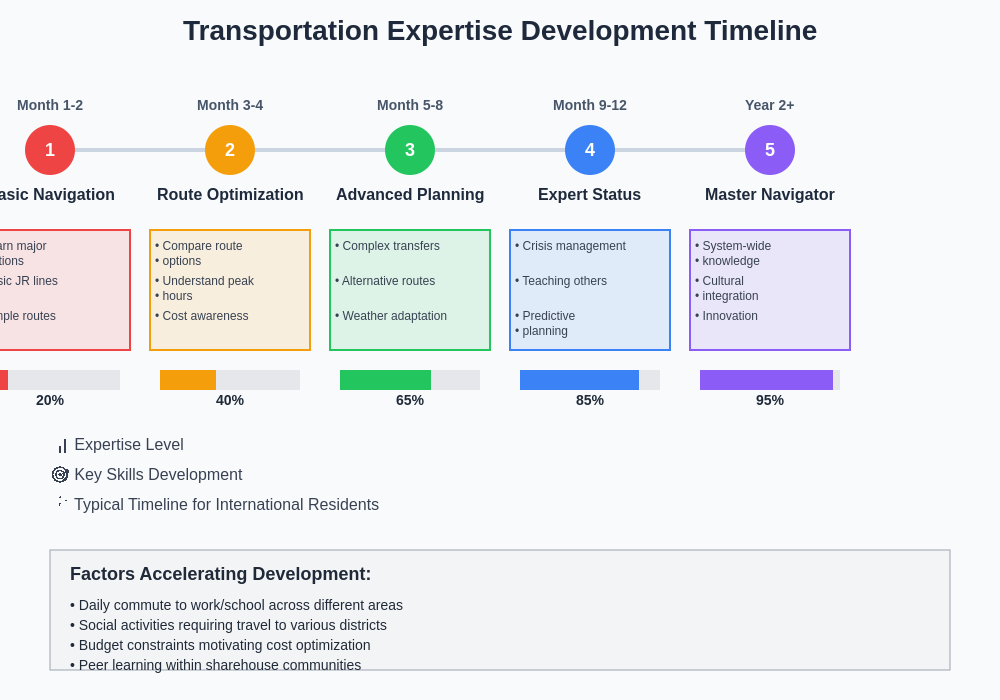
The geographical dispersion typical of sharehouse social networks means residents regularly travel to areas they might never visit as tourists or conventional residents. Friends from the sharehouse community often work in different districts, attend various schools, or pursue activities in specialized neighborhoods, creating a transportation learning laboratory that exposes residents to the full breadth of Tokyo’s transit options.
Economic Necessity Drives Innovation
The budget-conscious nature of most sharehouse residents creates powerful financial incentives to master cost-effective transportation strategies that extend far beyond simple route selection. Understanding the nuances of different ticket types, pass options, transfer discounts, and timing-based pricing variations becomes crucial for maintaining reasonable monthly transportation budgets while maximizing mobility and opportunity access.
Living costs in Tokyo sharehouses explained often reveals that transportation expenses represent a significant portion of monthly budgets, motivating residents to develop expertise in fare optimization that rivals professional commuters. This economic pressure transforms casual transit users into strategic planners who understand the financial implications of route choices and timing decisions.
The shared living environment creates natural opportunities for cost-sharing strategies and group travel planning that require sophisticated understanding of group discount options, off-peak scheduling, and multi-destination optimization. Residents learn to coordinate shopping trips, social outings, and recreational activities in ways that maximize transportation efficiency while minimizing individual costs.
Budget constraints also drive exploration of alternative transportation modes including bicycle routes, walking paths, and combination strategies that blend different transit types for optimal cost-effectiveness. This comprehensive approach to mobility develops a holistic understanding of Tokyo’s transportation ecosystem that extends far beyond traditional train-centric perspectives.
Social Learning and Knowledge Sharing
The multicultural environment of Tokyo sharehouses creates a unique collaborative learning laboratory where transportation knowledge flows freely between residents with different backgrounds, experiences, and destination needs. Making friends through Tokyo sharehouse communities naturally includes sharing transportation tips, route discoveries, and navigational strategies that accelerate the learning curve for all residents.
Experienced residents who have developed transportation expertise often become informal mentors for newcomers, sharing not just basic route information but sophisticated strategies for reading crowd patterns, predicting delays, identifying alternative options, and navigating complex transfer scenarios. This peer-to-peer knowledge transfer creates a collective intelligence that benefits the entire sharehouse community.
The diversity of resident destinations and schedules means that individual route discoveries quickly become shared community knowledge, with each person’s transportation challenges contributing to a growing database of solutions, shortcuts, and optimization strategies. Group messaging apps and common area conversations naturally evolve into ongoing transportation consultation sessions where residents help each other solve complex routing problems.
Social activities organized within sharehouse communities often require coordination of multiple people traveling from different starting points to shared destinations, creating practical exercises in group transportation planning that develop advanced logistical skills and collaborative problem-solving abilities.
Technology Integration and Digital Mastery
Modern sharehouse residents develop sophisticated proficiency with transportation apps, navigation systems, and digital tools that transform smartphones into powerful transit command centers. The constant need to find optimal routes under varying conditions drives mastery of multiple applications, each with specific strengths for different types of transportation challenges and real-time decision making.
How transportation apps change navigation habits becomes particularly relevant for sharehouse residents who push these digital tools to their limits, discovering advanced features and optimization strategies that casual users never explore. The combination of multiple apps with local knowledge creates a hybrid navigation approach that surpasses either pure digital or traditional methods.
Real-time adaptation skills develop as residents learn to interpret various data sources, from official delay announcements to crowd-sourced traffic information, weather impact predictions, and special event disruption warnings. This multi-source information processing capability enables dynamic route adjustment that maintains schedule reliability even under changing conditions.
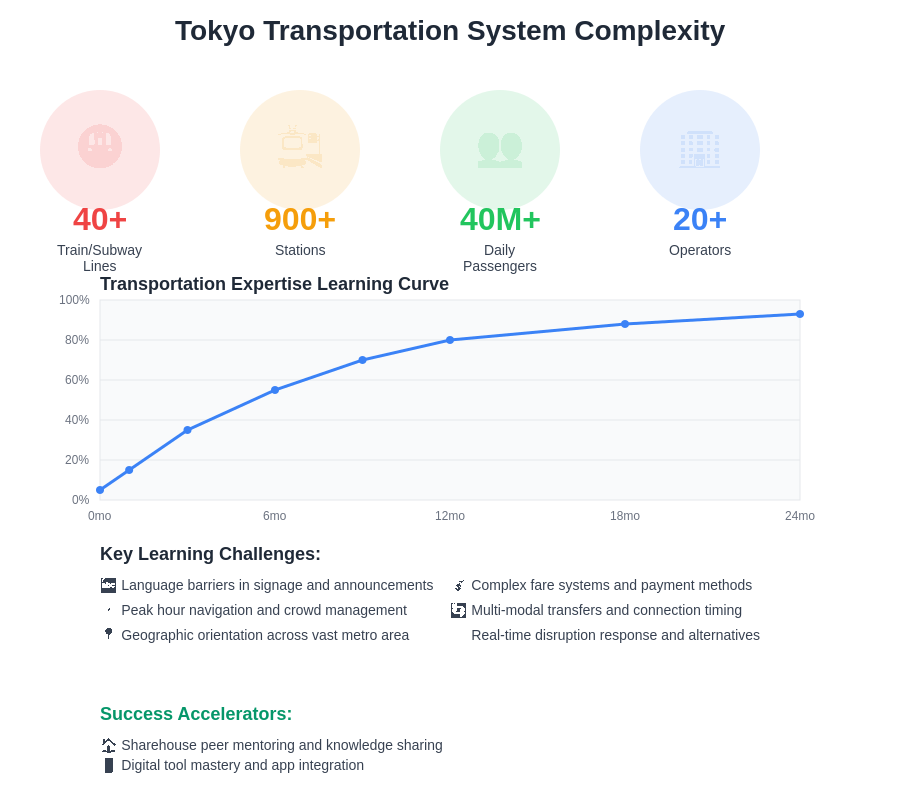
The integration of payment systems, reservation platforms, and scheduling tools with navigation apps creates a seamless digital transportation management system that residents use to coordinate complex multi-modal journeys with precision timing and cost optimization that would be impossible without technological assistance.
Pattern Recognition and Predictive Skills
Extended exposure to Tokyo’s transportation rhythms develops sophisticated pattern recognition abilities that enable residents to predict crowding levels, delay patterns, and optimal timing strategies based on subtle environmental and temporal cues. How rush hour timing affects work schedules becomes internalized knowledge that residents apply automatically without conscious analysis.
Understanding seasonal variations in transportation patterns, from summer festival disruptions to winter weather impacts, graduation ceremony crowd surges, and holiday schedule modifications, creates a predictive capability that enables proactive planning and contingency preparation. This temporal pattern recognition extends beyond basic schedule knowledge to encompass the complex interactions between weather, events, and human behavior that affect transit system performance.
Weather sensitivity develops as residents learn to anticipate how rain, snow, wind, and temperature affect different transportation modes and route options. This meteorological transportation expertise enables strategic pre-positioning and alternative planning that maintains mobility reliability regardless of weather conditions.
Special event impact prediction becomes second nature as residents learn to identify the transportation implications of festivals, concerts, sporting events, and seasonal celebrations that can dramatically alter normal route performance and require completely different navigation strategies.
Crisis Management and Contingency Planning
The unpredictable nature of urban transportation systems, from mechanical failures to emergency situations, weather disruptions, and special circumstances, creates regular opportunities for residents to develop crisis management skills and contingency planning abilities that serve them throughout their Tokyo experience and beyond.
How transportation strikes disrupt daily life provides practical education in alternative transportation strategies and emergency mobility solutions that residents must master to maintain their work, social, and practical commitments during system disruptions.
Emergency response capabilities develop as residents learn to quickly assess disruption scope, identify available alternatives, communicate effectively with affected parties, and implement backup plans that minimize schedule impact and maintain essential mobility. These crisis navigation skills often transfer to other life areas and professional contexts.
The shared living environment means that transportation disruptions often affect multiple residents simultaneously, creating collaborative problem-solving opportunities where residents pool resources, share information, and coordinate alternative solutions that benefit the entire community.
Geographic Knowledge and Mental Mapping
Constant navigation across Tokyo’s vast metropolitan area develops exceptional geographic knowledge and mental mapping abilities that enable residents to understand spatial relationships, distance estimations, and directional orientation with precision that rivals GPS systems. How distance from city center changes living experience becomes intuitive knowledge that residents apply to housing decisions, social planning, and daily logistics.
Ward-by-ward familiarity develops naturally as transportation needs expose residents to different areas of Tokyo, creating comprehensive geographic knowledge that encompasses not just major stations and landmarks but neighborhood characteristics, local amenities, and area-specific transportation options that few tourists or casual residents ever discover.
Three-dimensional spatial understanding evolves as residents learn to navigate Tokyo’s complex vertical transportation networks, from underground subway mazes to elevated train platforms, multi-level station complexes, and integrated shopping center transit hubs that require sophisticated spatial reasoning and landmark recognition abilities.
Time-distance relationships become internalized as residents develop accurate intuition for travel duration estimates under different conditions, enabling precise scheduling and realistic planning that accounts for variables like transfer time, walking distances, and crowd-related delays.
Cultural Integration Through Transportation
Mastering Tokyo’s transportation systems provides deep cultural insights and integration opportunities that extend far beyond mere mobility, offering windows into Japanese social norms, efficiency values, collective behavior patterns, and urban planning philosophies that shape daily life throughout the city.
Understanding how cultural differences impact daily transportation becomes practical experience as residents learn unwritten rules, etiquette expectations, and behavioral norms that govern public transportation use and social interaction within transit environments.
Observation skills develop as residents learn to read social cues, crowd dynamics, and behavioral patterns that help predict train car selection, transfer timing, and navigation strategies that minimize conflict and maximize efficiency within the cultural context of Japanese public transportation usage.
Language skills naturally improve through constant exposure to transportation-related vocabulary, announcement patterns, and signage systems that provide practical Japanese language education in context-rich environments where comprehension directly impacts daily success and convenience.
Professional and Personal Development
The advanced problem-solving skills, analytical thinking, and strategic planning abilities developed through transportation mastery often transfer to professional contexts where residents apply route optimization thinking, contingency planning approaches, and efficiency analysis methods to work challenges and career development opportunities.
How different career paths affect transportation needs demonstrates how transportation expertise influences professional choices and enables residents to consider job opportunities across wider geographic areas with confidence in their ability to manage complex commute requirements.
Personal confidence and independence develop as residents master one of Tokyo’s most intimidating challenges for newcomers, creating a sense of accomplishment and urban competence that extends to other areas of life and enables more adventurous exploration of cultural, social, and professional opportunities throughout the metropolitan area.
The networking opportunities created through transportation expertise, from helping other residents and travelers to engaging with local transportation staff and fellow commuters, often lead to unexpected social connections and professional relationships that enhance the overall Tokyo living experience.
Long-term Impact and Legacy Skills
The transportation expertise developed during sharehouse living creates lasting skills and knowledge that continue benefiting residents long after they transition to other living situations or even different cities. Understanding complex urban transit systems, optimization thinking, and navigation problem-solving approaches transfer to other metropolitan environments worldwide.
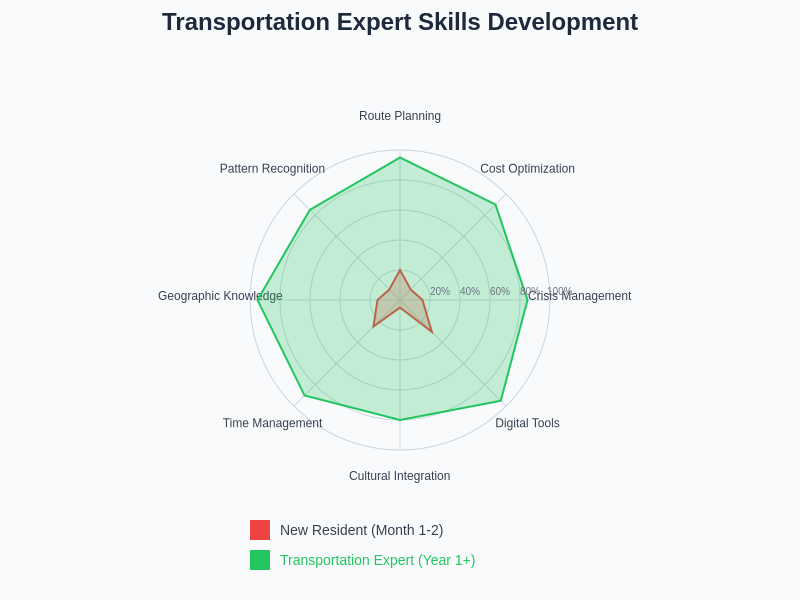
How sharehouse living prepares you for future challenges includes transportation mastery as one of the key competencies that residents carry forward into their personal and professional development, enabling confident urban navigation and mobility optimization regardless of location.
The analytical thinking and systematic approach to complex logistical challenges that transportation expertise requires often influence career development, particularly in fields requiring project management, operations optimization, or strategic planning capabilities that mirror the skills developed through daily transportation problem-solving.
Teaching and mentoring abilities develop as experienced residents help newcomers navigate Tokyo’s transportation challenges, creating leadership opportunities and communication skills that prove valuable in various professional and personal contexts throughout life.
The transformation from confused newcomer to transportation expert represents more than simple skill acquisition; it embodies the broader adaptation process that sharehouse living facilitates, where practical challenges drive rapid learning, cultural integration, and personal development that creates lasting confidence and capability for navigating complex urban environments anywhere in the world.
Disclaimer
This article is for informational purposes only and reflects general observations about sharehouse resident experiences. Individual transportation needs, learning speeds, and expertise development may vary significantly based on personal circumstances, location, and length of residence. Transportation systems, routes, and costs in Tokyo are subject to change, and readers should verify current information when making travel decisions.