The phenomenon of conversation exclusion in Tokyo sharehouses represents one of the most emotionally challenging aspects of shared living that can transform what should be a welcoming community environment into a source of isolation and social anxiety. This complex issue stems from multiple interconnected factors including language proficiency disparities, cultural communication patterns, established social hierarchies, and unconscious bias that collectively create barriers preventing some residents from participating meaningfully in house conversations and social interactions.
Understanding why certain residents experience systematic exclusion from conversations requires examining both the overt and subtle mechanisms that operate within sharehouse social dynamics. The impact extends far beyond simple social discomfort, affecting residents’ mental health, language learning progress, cultural adaptation, and overall satisfaction with their Tokyo living experience, often leading to premature departures from otherwise suitable housing situations.
The Language Proficiency Hierarchy
Language ability often creates invisible but powerful hierarchies within sharehouse communities that determine conversation participation levels and social integration opportunities. Residents with advanced Japanese or English skills naturally gravitate toward positions of informal leadership and become central figures in house discussions, while those with limited proficiency find themselves relegated to observer roles even when they possess valuable insights or strong desire to contribute to community decisions.
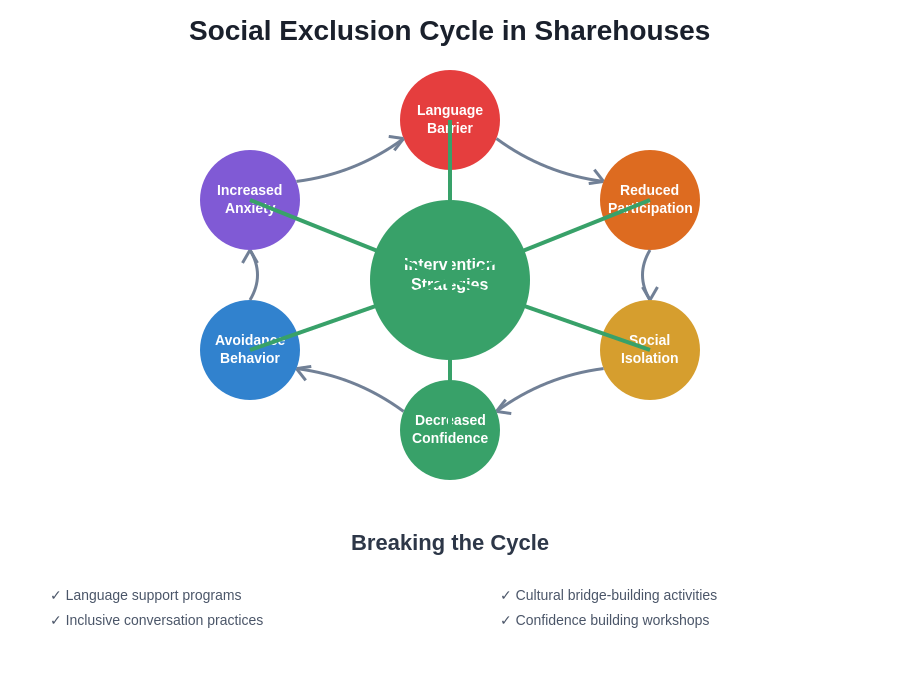
The speed and complexity of natural conversation frequently exceed the comfort zones of language learners, creating situations where residents must choose between attempting participation and risking embarrassment or remaining silent and becoming increasingly marginalized. Language barriers that prevent deep friendships illustrates how these communication challenges compound over time, creating self-reinforcing cycles of exclusion.
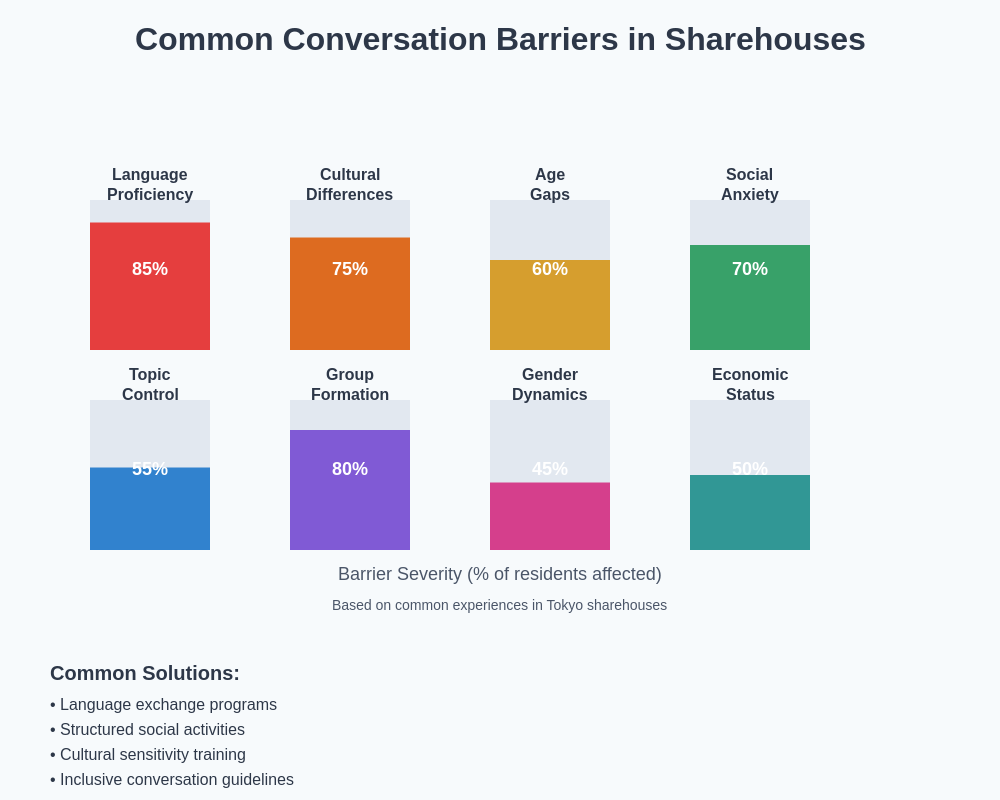
Native speakers and highly proficient multilingual residents often unconsciously dominate conversations through rapid speech patterns, cultural references, slang usage, and topic selection that assumes shared linguistic and cultural knowledge. The cognitive load required for non-native speakers to process, formulate responses, and participate meaningfully in these fast-paced exchanges can be exhausting, leading to voluntary withdrawal from social situations that should foster community building.
Cultural Communication Style Conflicts
Different cultural backgrounds bring distinct communication patterns and social interaction expectations that can create unintentional exclusion when dominant cultural styles emerge within sharehouse environments. Direct versus indirect communication preferences, volume levels, personal space requirements, topic appropriateness, and turn-taking conventions vary significantly across cultures, leading to situations where some residents feel overwhelmed or unable to find natural entry points into ongoing conversations.
High-context cultures that rely heavily on nonverbal cues, implied meanings, and shared cultural understanding often struggle in environments dominated by low-context communicators who prioritize explicit verbal expression and direct statement of opinions and preferences. Cultural communication styles that create misunderstandings explores how these fundamental differences in interaction patterns affect daily social dynamics.
The establishment of unofficial house languages, whether Japanese, English, or other dominant languages spoken by resident majorities, can systematically exclude individuals who lack proficiency in these preferred communication mediums. Even multilingual residents may find their participation limited when conversations occur in their non-dominant languages, particularly during complex discussions about house rules, social events, or conflict resolution.
Group Formation and Social Clustering
Natural human tendencies toward homophily and in-group formation create social clusters within sharehouses that can unintentionally exclude residents who don’t share common characteristics such as nationality, age, profession, interests, or lifestyle preferences. These informal groups develop shared jokes, references, activities, and conversation topics that become increasingly inaccessible to outsiders, creating parallel social worlds within the same physical space.
Early arrival advantages and established relationship networks give certain residents privileged positions in social hierarchies that new arrivals struggle to penetrate. Making friends through Tokyo sharehouse communities highlights how timing and social positioning affect integration opportunities and long-term community acceptance.
Professional and educational backgrounds also influence conversation accessibility, as discussions about work experiences, academic pursuits, career aspirations, and industry-specific topics can exclude residents from different professional spheres or educational levels. The unconscious assumption that everyone shares similar life experiences or educational foundations creates barriers for residents with diverse backgrounds or alternative life paths.
Personality and Social Energy Mismatches
Individual personality differences and social energy levels significantly impact conversation participation patterns and community integration success rates within sharehouse environments. Introverted residents often struggle in communities dominated by extroverted personalities who naturally command attention, initiate conversations, and maintain high-energy social interactions that can feel overwhelming or exclusionary to those who prefer quieter, more intimate communication styles.
Cultural variations in extroversion and social interaction expectations compound these personality-based challenges, as some cultures value animated group discussions while others prioritize respectful listening and measured responses. Residents from cultures that emphasize humility and deference may find themselves unable to compete for conversational space in environments where assertiveness and self-promotion are normalized social behaviors.
Social anxiety and confidence levels, often exacerbated by language barriers and cultural adjustment stress, create additional obstacles for residents attempting to integrate into established social dynamics. Building real friendships takes longer than expected examines how these psychological factors influence relationship formation and community participation patterns.
Age and Life Stage Disparities
Significant age gaps within sharehouse communities create natural conversation divides based on different life experiences, cultural references, technology usage patterns, and priority structures that can make meaningful cross-generational interaction challenging. Younger residents often dominate conversations with topics related to social media, entertainment trends, dating experiences, and career exploration that may feel irrelevant or inaccessible to older residents with different life stage concerns.
Professional experience levels and career advancement stages influence conversation topics and social dynamics, as residents at different professional development phases may struggle to find common ground for meaningful discussion. Age differences that impact sharehouse compatibility explores how these generational and professional gaps affect daily interactions and community cohesion.
Educational backgrounds and intellectual interests also create conversation accessibility barriers when discussions assume shared knowledge bases, cultural literacy, or academic experiences that not all residents possess. The unconscious elevation of certain types of knowledge or educational achievements can marginalize residents with practical skills, alternative educational paths, or different intellectual interests.
Economic and Social Status Influences
Financial disparities among residents often manifest in conversation topics, activity suggestions, and lifestyle discussions that unintentionally exclude those with more limited economic resources. Discussions about expensive restaurants, international travel, luxury purchases, or costly entertainment options can create feelings of exclusion among residents operating under tighter budget constraints.
Social backgrounds and family economic situations influence conversation accessibility when residents share stories, experiences, or assumptions based on privileged backgrounds that others cannot relate to or participate in meaningfully. Living costs in Tokyo sharehouses addresses how economic pressures affect social participation and community engagement opportunities.
Professional networking discussions and career advancement conversations can exclude residents in different economic situations, such as students, part-time workers, or those in transitional employment phases. The assumption that everyone shares similar professional aspirations or economic opportunities creates barriers for residents with different life circumstances or constraints.
Gender Dynamics and Social Positioning
Gender-based conversation patterns and social dynamics within sharehouses can create exclusion through topic selection, communication styles, interaction patterns, and unconscious bias that privileges certain voices while marginalizing others. Mixed-gender environments often develop gendered conversation clusters that limit cross-gender interaction and create separate social spheres within shared spaces.
Cultural variations in gender interaction norms and expectations compound these challenges, as residents from cultures with strict gender separation may struggle in environments with casual mixed-gender socializing, while those from egalitarian backgrounds may feel restricted in communities that maintain traditional gender role expectations. Gender-specific sharehouses have different rules examines how these dynamics influence social interaction patterns.
Power dynamics and informal leadership roles often align with gender patterns that can systematically exclude certain residents from decision-making conversations and influence opportunities. The intersection of gender with other factors such as nationality, language ability, and cultural background creates complex exclusion patterns that affect both social integration and practical participation in house management.
Topic Control and Interest Monopolization
Dominant personalities within sharehouse communities often control conversation topics through persistent focus on their personal interests, professional concerns, or cultural preferences that may not resonate with other residents. This topic monopolization creates environments where certain subjects receive disproportionate attention while alternative interests or concerns remain unexplored or dismissed.
Technical discussions about specialized hobbies, professional fields, or cultural phenomena can exclude residents without relevant background knowledge or interest, particularly when these topics dominate common area conversations regularly. The assumption that everyone shares enthusiasm for particular subjects or activities creates barriers for residents with different intellectual curiosities or recreational preferences.
Repetitive conversation patterns and limited topic diversity can make social interactions feel predictable and exclusionary for residents whose interests or expertise lie outside established discussion parameters. Why some conversations always stay surface level explores how these limitations affect relationship depth and community engagement.
Physical Space and Social Geography
The physical layout of sharehouse common areas and the informal claiming of social territories can create conversation accessibility barriers that exclude residents from natural interaction opportunities. Prime seating arrangements, kitchen timing, and common area usage patterns often favor early residents or those with more assertive personalities, leaving others with less favorable positioning for social engagement.
Timing patterns and schedule alignments affect conversation participation opportunities, as residents with different work schedules, study commitments, or lifestyle patterns may miss the informal social periods when community bonding and decision-making conversations typically occur. Rush hour timing affects work schedules illustrates how daily routines impact social integration opportunities.
Noise levels and acoustic challenges in common areas can make conversation participation difficult for residents with hearing sensitivities, language processing challenges, or those who struggle with competing audio inputs in group discussion environments.
Strategies for Addressing Conversation Exclusion
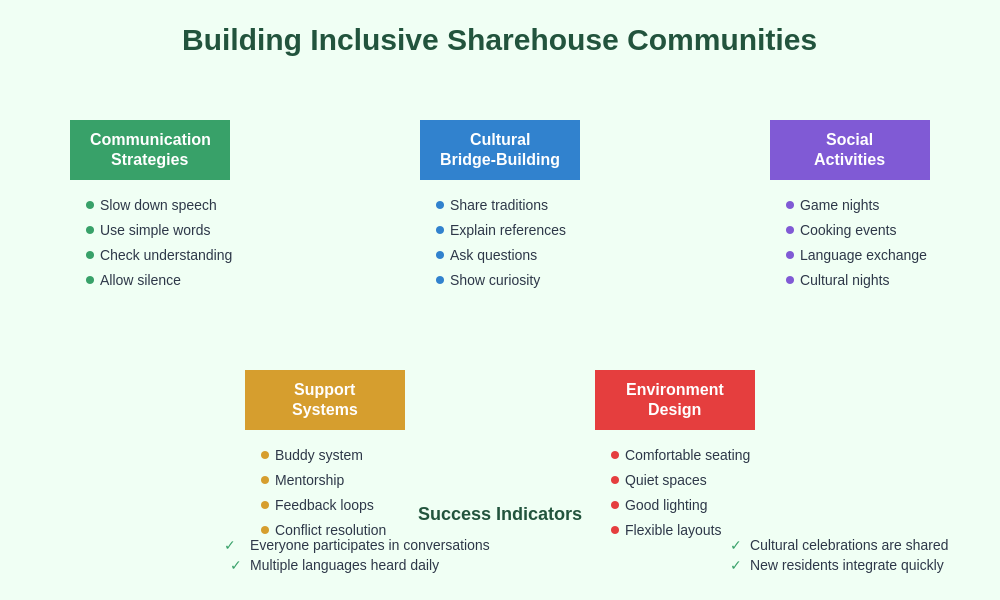
Recognizing and addressing conversation exclusion requires intentional effort from both individual residents and house management to create more inclusive social environments that welcome diverse participation styles and communication preferences. Establishing conversation norms that encourage turn-taking, topic diversity, and inclusive language practices can help create more welcoming social dynamics for all residents.
Language support systems such as conversation practice groups, multilingual discussion periods, and patience protocols for non-native speakers can reduce barriers for residents struggling with language proficiency challenges. Creating structured social activities that don’t rely heavily on rapid conversational participation allows different personality types and communication styles to contribute meaningfully to community building.
Cultural sensitivity training and awareness building help residents understand how their communication patterns may unintentionally exclude others, fostering more conscious inclusion practices and respectful interaction norms. How to handle roommate conflicts without moving out provides practical approaches for addressing social dynamics issues constructively.
Long-term Impact and Resolution Approaches
Conversation exclusion in sharehouses can have lasting effects on residents’ confidence, language learning progress, cultural adaptation, and overall mental health that extend far beyond the immediate living situation. Understanding these impacts helps both excluded residents and house communities recognize the importance of addressing social inclusion challenges proactively.
Building inclusive communities requires ongoing attention to social dynamics, regular assessment of participation patterns, and willingness to adjust communication norms and social practices to accommodate diverse resident needs and preferences. The creation of multiple social interaction opportunities with varying communication requirements allows residents with different strengths and comfort levels to contribute meaningfully to house communities.
Successful inclusion strategies often involve peer mentorship programs, structured social activities, language exchange partnerships, and conflict resolution systems that address exclusion patterns before they become entrenched social norms. The investment in inclusive practices benefits entire sharehouse communities by creating richer cultural exchange opportunities and more supportive living environments for all residents.
The experience of conversation exclusion in Tokyo sharehouses reflects broader challenges of international living and cross-cultural community building that require conscious effort, cultural sensitivity, and commitment to inclusive practices from all community members. By understanding and addressing the complex factors that contribute to social exclusion, sharehouse communities can create more welcoming environments that truly fulfill the promise of international co-living and cultural exchange.
Disclaimer
This article is for informational purposes only and reflects common experiences in sharehouse living situations. Individual experiences may vary, and the social dynamics described may not apply to all sharehouse communities. Readers experiencing social exclusion should consider speaking with house management or seeking appropriate support. The strategies mentioned may require adaptation to specific cultural contexts and community dynamics.