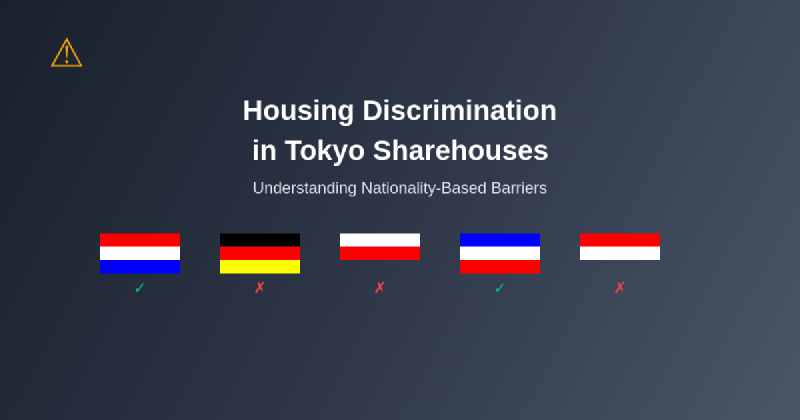
The practice of nationality-based discrimination in Japanese sharehouses represents a complex intersection of cultural biases, business risk management, language barriers, and historical experiences that create systematic exclusion of certain groups from housing opportunities. Understanding these underlying factors provides essential insight into the challenges faced by international residents and the systemic issues that perpetuate housing inequality in Japan’s rental market.
This discrimination manifests in various forms, from explicit nationality restrictions in advertisements to subtle screening processes that effectively exclude certain groups while maintaining plausible legal cover. The persistence of these practices despite anti-discrimination laws highlights the gap between legal protections and practical enforcement in Japan’s housing market, particularly affecting the most vulnerable international residents seeking affordable accommodation.
Historical Context and Cultural Factors
Japan’s historical isolation and relatively recent experience with large-scale international immigration have created cultural attitudes that influence housing decisions, with some property managers relying on stereotypes and generalizations about different nationalities that may not reflect individual characteristics or behavior patterns. Japanese sharehouse rules every foreigner should know often reflects cultural expectations that some operators assume vary by nationality.
Past negative experiences with specific nationality groups, whether real or perceived, create lasting impressions that influence future rental decisions, even when such generalizations are statistically invalid and legally questionable. These experiences become amplified through industry networks where property managers share anecdotal evidence that reinforces existing biases rather than objective evaluation criteria.
Cultural communication styles and behavioral norms that differ between nationalities sometimes create genuine compatibility concerns for property managers who prioritize community harmony and conflict avoidance. However, these concerns often become exaggerated into blanket exclusions rather than individual assessments of compatibility and cultural adaptability.
The concept of cultural fit becomes a convenient justification for discrimination when property managers lack experience or training in cross-cultural communication and conflict resolution, leading to risk-averse policies that exclude entire nationality groups rather than developing inclusive management practices.
Business and Risk Management Considerations
Financial risk assessment drives many nationality-based restrictions, with property managers associating certain countries with higher rates of payment default, early termination, or difficulty in debt collection that influences their willingness to accept applicants from those backgrounds. How previous rental history affects applications becomes complicated when managers make assumptions based on nationality rather than individual credit history.
Language barriers create operational challenges for property managers who lack multilingual capabilities, leading to preferences for nationalities with stronger English or Japanese language skills to minimize communication difficulties and potential misunderstandings about house rules and procedures. Why background checks take longer for foreigners often involves assumptions about communication abilities based on nationality.
Insurance and liability concerns influence rental decisions when property managers believe certain nationalities pose higher risks for property damage, noise complaints, or conflicts with neighbors, even when such beliefs lack statistical foundation and may violate fair housing principles.
Market positioning strategies sometimes involve targeting specific demographic groups while excluding others to maintain a particular house atmosphere or community composition that appeals to their preferred resident base. Making friends through Tokyo sharehouse communities can be affected when artificial nationality restrictions limit community diversity.
Legal Framework and Enforcement Challenges
Japanese anti-discrimination laws provide legal protections against nationality-based housing discrimination, but enforcement mechanisms remain weak and complaints are often difficult to prove when discrimination occurs through indirect means rather than explicit rejection statements. How legal disputes get resolved in sharehouses addresses the complexity of pursuing discrimination claims through legal channels.
Burden of proof requirements make discrimination cases challenging to pursue when property managers can cite alternative reasons for rejection, such as income requirements, guarantor availability, or timing considerations that provide legal cover for discriminatory decisions. Documentation of discriminatory intent becomes nearly impossible when rejection communications avoid explicit nationality references.
Regulatory oversight of the sharehouse industry remains limited, with many operators functioning without specific licensing requirements that would subject them to anti-discrimination monitoring and enforcement actions. The fragmented nature of industry regulation creates opportunities for discriminatory practices to continue without meaningful accountability.
International treaty obligations under various human rights agreements create theoretical protections against housing discrimination, but practical enforcement through international pressure or diplomatic channels rarely addresses individual cases of sharehouse discrimination effectively.
Economic and Market Dynamics
Supply and demand imbalances in Tokyo’s housing market allow property managers to be selective in their tenant choices, reducing economic incentives to eliminate discriminatory practices when sufficient applicants from preferred nationalities remain available. Living costs in Tokyo sharehouses explained affects different nationality groups differently based on their access to housing options.
Competitive pressure among sharehouses for desirable tenants sometimes leads to nationality-based targeting strategies that exclude groups perceived as less stable or profitable, creating market segmentation that reinforces discriminatory patterns across the industry.
Economic dependency on specific nationality groups can create reverse discrimination situations where certain nationalities receive preferential treatment to maintain community composition or appeal to particular market segments, while other groups face systematic exclusion.
Rent collection efficiency concerns drive preferences for nationalities with established banking relationships, stable employment patterns, and familiarity with Japanese payment systems, though these preferences often extend beyond practical considerations into stereotypical assumptions about financial reliability.
Impact on International Communities
Housing search difficulties for affected nationality groups create additional stress, extended search periods, and increased costs that disproportionately burden certain international residents and may force them into substandard housing situations or locations far from work and study opportunities. How to find the perfect sharehouse in Tokyo becomes significantly more challenging when nationality-based restrictions limit available options.
Community segregation results when discrimination concentrates certain nationality groups in specific sharehouses or neighborhoods, reducing opportunities for cultural exchange and integration that represent key benefits of international sharehouse living. Living with Japanese roommates in Tokyo sharehouses becomes impossible when discriminatory practices prevent diverse community formation.
Professional and educational impacts occur when housing discrimination forces international residents to choose accommodations based on availability rather than proximity to work or study locations, affecting career development and academic performance through increased commute times and reduced networking opportunities.
Psychological effects of repeated discrimination include decreased self-esteem, increased anxiety about housing security, and negative perceptions of Japanese society that can affect long-term integration and contribution to local communities.
Mitigation Strategies and Alternative Approaches
Legal advocacy organizations provide support for discrimination victims through complaint filing assistance, legal representation, and documentation of systematic discrimination patterns that can support broader enforcement actions against problematic operators. How to spot financial red flags in sharehouse contracts includes guidance on identifying discriminatory practices in rental agreements.
Alternative housing platforms and specialized operators focus on providing non-discriminatory housing options for international residents, though these alternatives may offer limited choices or higher costs that create additional barriers for affected nationality groups.
Embassy and consulate intervention can provide diplomatic pressure and support for serious discrimination cases, though effectiveness varies based on bilateral relationships and the priority given to housing rights issues by respective governments.
Community organizing efforts bring together affected residents to document discrimination patterns, share information about fair housing options, and advocate for stronger enforcement of existing anti-discrimination laws through collective action and public awareness campaigns.
Industry Reform and Future Outlook
Professional training programs for property managers and sharehouse operators address unconscious bias, cultural competency, and legal compliance requirements that can reduce discrimination through education rather than enforcement, though participation in such training remains largely voluntary.
Industry certification and standards development could create accountability mechanisms that require anti-discrimination policies and practices as conditions for legitimate operation in the sharehouse market, though such initiatives require industry cooperation and regulatory support.
Technology solutions including blind application processes and algorithmic screening tools may reduce opportunities for nationality-based discrimination by focusing evaluation on objective criteria rather than personal characteristics, though implementation requires industry adoption and proper oversight.
Government policy initiatives addressing housing discrimination through stronger enforcement mechanisms, penalties for violations, and positive incentives for inclusive practices could create systemic change in industry practices, though political will for such reforms remains uncertain.
The persistence of nationality-based discrimination in Japanese sharehouses reflects deeper societal challenges around cultural diversity, immigration integration, and equal opportunity enforcement that extend beyond housing policy into broader questions of social inclusion and human rights protection. Addressing these issues requires sustained effort from legal advocates, community organizations, industry leaders, and government officials working together to create meaningful change in housing access and opportunity for all international residents regardless of their nationality or background.
Disclaimer
This article examines housing discrimination issues for educational and awareness purposes and does not constitute legal advice. Discrimination laws and enforcement mechanisms vary by jurisdiction and specific circumstances. Individuals experiencing housing discrimination should consult with qualified legal professionals and advocacy organizations for guidance specific to their situation. The information provided reflects general patterns and may not apply to all sharehouses or operators.