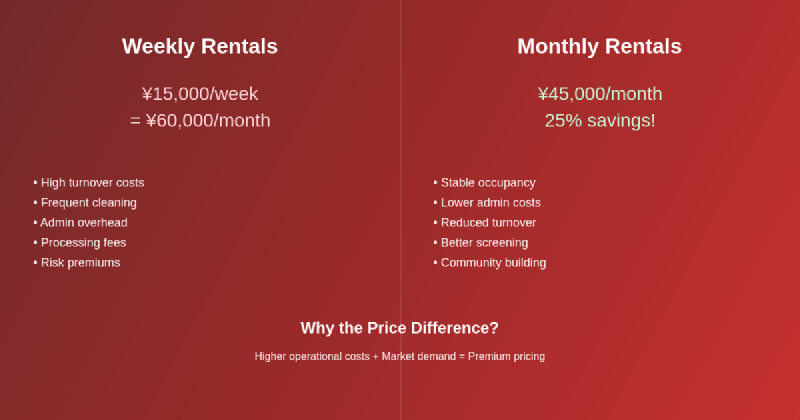
The pricing disparity between weekly and monthly sharehouse rentals represents one of the most significant economic factors affecting short-term residents and travelers in Tokyo’s accommodation market. Understanding why weekly rentals consistently command premium pricing compared to monthly alternatives requires examining the complex interplay of operational costs, market dynamics, administrative overhead, and risk management strategies that property operators employ to maintain profitable business models while serving diverse resident demographics.
The economics of short-term versus long-term accommodation pricing extends far beyond simple daily rate calculations, encompassing sophisticated business considerations that reflect the true costs and risks associated with high-turnover rental models. Property managers must balance attractive pricing for potential residents while covering elevated operational expenses and maintaining sustainable profit margins that justify the additional complexity inherent in weekly rental arrangements.
Understanding the Economics of High-Turnover Rentals
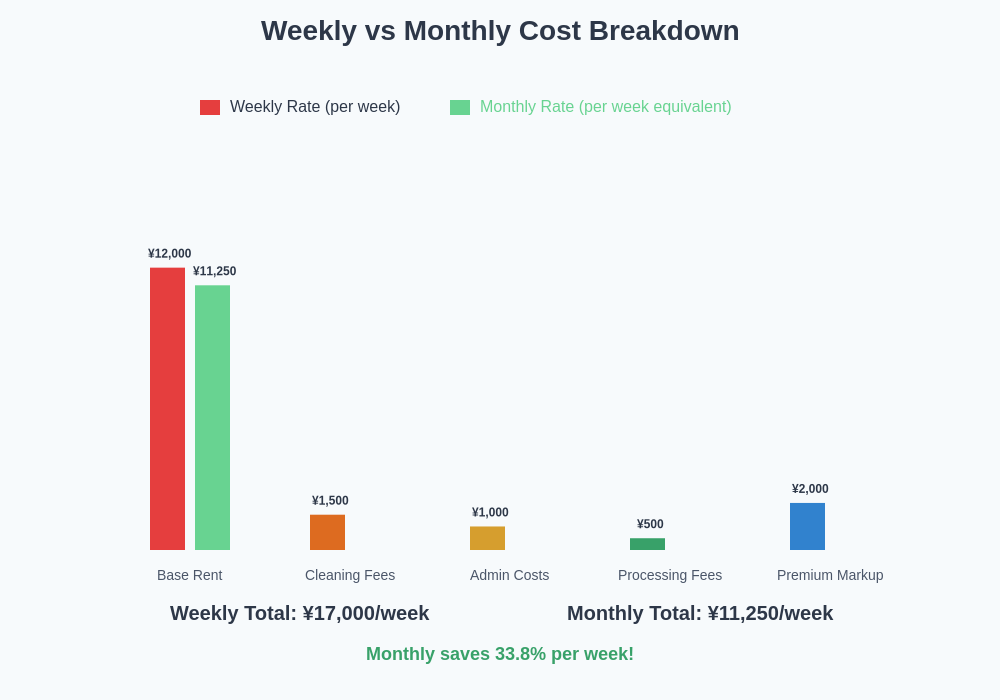
Weekly rental pricing structures reflect the fundamental economic reality that frequent tenant turnover creates substantially higher operational costs per occupied day compared to stable monthly arrangements. How much Tokyo sharehouses really cost per month provides baseline understanding of standard monthly pricing, while weekly rates typically represent premiums of thirty to fifty percent above equivalent monthly calculations.
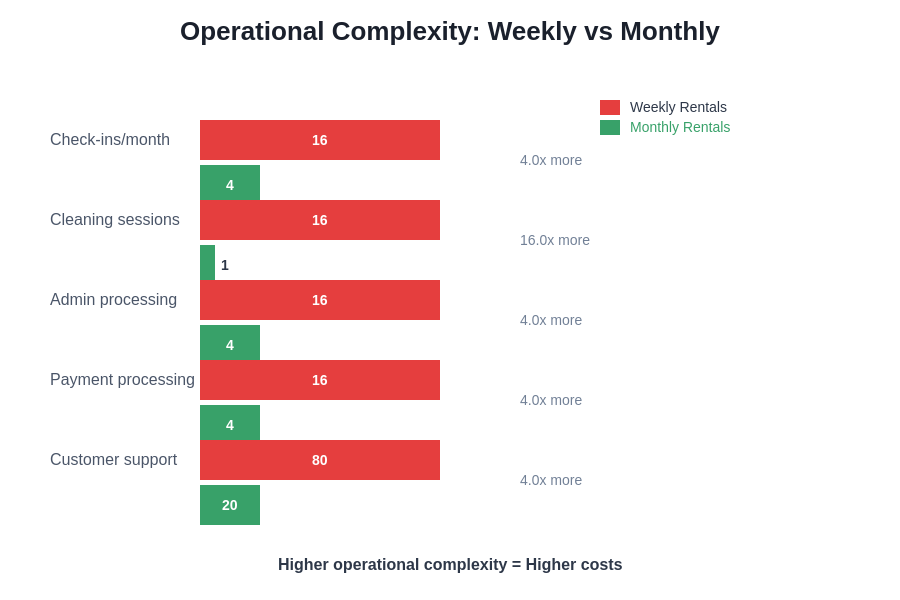
The increased frequency of check-ins, check-outs, room turnovers, and administrative processing creates labor-intensive workflows that require dedicated staff time and resources. Property operators must schedule cleaning services, conduct property inspections, process security deposits, and handle key exchanges multiple times per month rather than once monthly, multiplying administrative workload significantly without proportional increases in rental income duration.
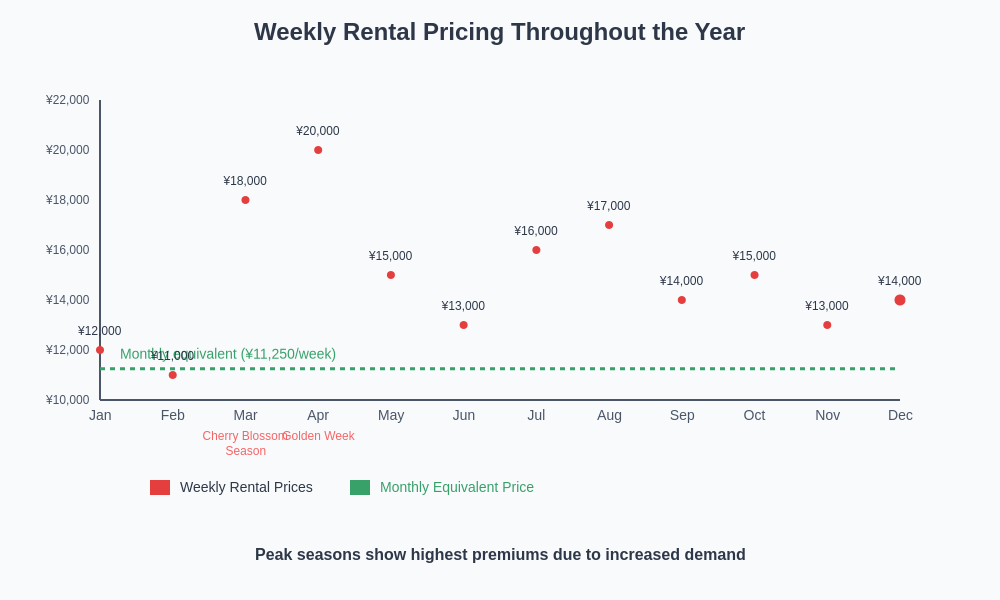
Market demand patterns for weekly accommodations typically concentrate during peak travel seasons, business conference periods, and academic transitions, creating supply-demand imbalances that justify premium pricing during high-demand periods while requiring operators to maintain capacity during slower periods when weekly demand diminishes substantially.
Administrative Overhead and Processing Complexity
The administrative burden associated with weekly rentals exponentially increases operational complexity through frequent documentation processing, background verification procedures, and payment handling requirements that occur four times more frequently than monthly arrangements. What documents you need for Tokyo sharehouse applications outlines standard requirements that must be completed repeatedly for each weekly tenant.
Payment processing fees, credit card transaction costs, and international money transfer charges accumulate rapidly when applied to frequent weekly payments rather than single monthly transactions. Financial institutions typically charge flat fees per transaction regardless of amount, making frequent small payments significantly more expensive per dollar processed than larger monthly payments.
Documentation verification, identity confirmation, and emergency contact validation require substantial staff time investment for each new resident, regardless of stay duration. Weekly residents receive the same thorough screening and onboarding processes as monthly residents, but operators must recover these costs over much shorter revenue-generating periods.
Customer service requirements intensify dramatically with weekly residents who often need immediate assistance with neighborhood orientation, transportation guidance, and cultural adaptation support that monthly residents gradually develop independently over extended periods. Living with Japanese roommates in Tokyo sharehouses highlights integration challenges that weekly residents experience more acutely.
Increased Cleaning and Maintenance Expenses
Room turnover frequency directly correlates with cleaning and maintenance requirements that escalate costs substantially beyond normal wear-and-tear expectations. Weekly residents typically require comprehensive room cleaning, linen changes, and deep sanitization between each stay, compared to monthly residents who maintain their own spaces and require minimal turnover services.
Professional cleaning services charge premium rates for frequent, intensive cleaning sessions that include complete room reset, bathroom sanitization, and common area maintenance required between short-term stays. These services often command higher per-visit pricing due to the specialized nature and time-sensitive scheduling requirements of rapid turnover cleaning.
Furniture and facility wear accelerates significantly with frequent resident changes as different individuals with varying habits and care standards utilize shared spaces and amenities. Weekly residents may lack the long-term investment mindset that encourages careful treatment of shared property, leading to increased maintenance and replacement costs.
Utility consumption patterns differ markedly between weekly and monthly residents, with short-term stays typically involving higher electricity, water, and heating usage as residents prioritize immediate comfort over conservation mindfulness that develops through extended residence periods.
Risk Management and Security Considerations
Weekly rental arrangements inherently carry elevated financial and operational risks that operators must price into their rate structures to maintain sustainable business models. How to spot financial red flags in sharehouse contracts discusses various risk factors that become magnified in short-term rental scenarios.
Default risk increases substantially with weekly arrangements as residents have limited investment in maintaining positive relationships with property managers and fellow residents. The abbreviated timeframe reduces accountability and increases likelihood of payment delays, property damage, or sudden departure without proper notice.
Security deposit management becomes significantly more complex with weekly rentals as operators must quickly assess and process potential damage claims, cleaning fees, and missing item charges within compressed timeframes that limit thorough investigation and dispute resolution opportunities.
Background verification limitations create inherent security risks as abbreviated application timelines prevent comprehensive character assessment and reference checking that longer application processes enable. Weekly rental applicants often require immediate accommodation, pressuring operators to make rapid approval decisions with limited verification time.
Community disruption potential intensifies with frequent resident turnover as established house dynamics experience regular interruption from newcomers who may not understand or respect established social norms and house rules. Making friends through Tokyo sharehouse communities emphasizes how stable relationships require time investment incompatible with weekly arrangements.
Market Demand and Supply Dynamics
Peak season demand for weekly accommodations creates pricing opportunities that allow operators to charge premium rates during high-demand periods while offsetting lower occupancy during slower periods. Business travel seasons, academic conferences, and tourist influxes generate concentrated demand that justifies elevated pricing through basic supply-demand economics.
Limited availability of quality weekly accommodation options in Tokyo’s sharehouse market enables premium pricing as demand consistently exceeds supply during peak periods. Best Tokyo neighborhoods for sharehouse living highlights desirable areas where weekly options command highest premiums due to location advantages and limited supply.
Corporate housing demand drives substantial premium pricing as business travelers and relocating professionals often receive accommodation allowances that enable higher spending on convenient short-term housing solutions. These market segments typically prioritize convenience and quality over cost optimization, supporting elevated pricing structures.
International student and working holiday demographics create seasonal demand spikes that coincide with academic calendars and visa approval periods, enabling operators to implement dynamic pricing strategies that maximize revenue during predictable high-demand windows.
Operational Efficiency Challenges
Weekly rental operations require sophisticated scheduling and coordination systems that exceed the complexity requirements of monthly rental management. Japanese sharehouse rules every foreigner should know outlines standards that must be communicated repeatedly to new weekly residents rather than once to stable monthly tenants.
Staff scheduling must accommodate irregular check-in and check-out times that occur throughout the week rather than concentrated monthly move-in periods. This requires higher staffing levels and more flexible scheduling arrangements that increase labor costs significantly.
Inventory management becomes substantially more complex as weekly turnovers require constant monitoring of linens, towels, basic amenities, and room supplies that monthly residents typically maintain independently. Replacement and restocking frequencies increase dramatically with high turnover rates.
Communication systems must handle much higher volumes of inquiries, booking requests, and support needs from prospective and current weekly residents who require immediate responses and assistance. Customer service workload increases exponentially with shortened stay durations and compressed decision timeframes.
Pricing Strategy and Revenue Optimization
Weekly pricing strategies must balance market competitiveness with cost recovery requirements that reflect true operational expenses and appropriate profit margins. Living costs in Tokyo sharehouses explained provides context for understanding how weekly premiums affect overall accommodation budgeting.
Dynamic pricing models enable operators to adjust weekly rates based on occupancy forecasts, seasonal demand patterns, and competitive market conditions. Premium pricing during high-demand periods helps offset lower occupancy rates during slower periods when weekly demand diminishes substantially.
Minimum stay requirements and advance booking policies help operators manage operational complexity while ensuring adequate revenue generation to justify the administrative overhead associated with short-term arrangements. Some properties implement sliding scales where longer weekly stays receive modest discounts while maintaining premium pricing for single-week bookings.
Package pricing strategies often bundle additional services such as cleaning, utilities, and amenities into weekly rates to simplify billing while ensuring comprehensive cost recovery for all services required to maintain high-turnover operations successfully.
Long-term Financial Implications for Residents
Extended weekly rental stays create significantly higher accommodation costs compared to equivalent monthly arrangements, making this option financially sustainable only for short-term needs or situations where monthly commitments prove impossible. How to budget realistically for sharehouse living emphasizes importance of accurate cost projections for different rental arrangements.
Budget planning for weekly accommodations requires careful consideration of cumulative costs that can exceed monthly alternatives by substantial margins over extended periods. Residents planning stays longer than one month typically benefit significantly from transitioning to monthly arrangements despite potential inconvenience.
Opportunity costs associated with weekly premium pricing include reduced funds available for other living expenses, entertainment, travel, and savings goals that could enhance overall Tokyo experience quality. High accommodation costs can limit exploration opportunities and cultural activities that justify living in Tokyo initially.
Financial flexibility decreases with weekly rental commitments as higher costs reduce available emergency funds and limit ability to respond to unexpected expenses or opportunities that arise during Tokyo residence periods.
Alternative Strategies and Cost Mitigation
Advance booking discounts and longer weekly commitments sometimes offer modest premium reductions while maintaining operational advantages for property managers. Early booking allows better operational planning and guaranteed occupancy that justifies small pricing concessions.
Seasonal timing strategies can help residents access weekly accommodations during lower-demand periods when operators may offer competitive rates to maintain occupancy levels. Seasonal demand affects sharehouse prices explains how timing affects accommodation costs significantly.
Negotiation opportunities may exist for extended weekly stays or repeat bookings that provide operational benefits to property managers through reduced marketing costs and guaranteed occupancy periods. Establishing positive relationships with operators can lead to preferential pricing for future bookings.
Alternative accommodation types including short-term monthly rentals, extended-stay hotels, and furnished apartment options may provide cost-effective alternatives to premium weekly sharehouses depending on specific needs and preferences.
The fundamental economics driving weekly rental premiums reflect legitimate business considerations and operational realities rather than arbitrary pricing decisions. Understanding these factors helps residents make informed accommodation choices that balance convenience needs with budget constraints while appreciating the true costs associated with high-turnover rental operations in Tokyo’s competitive housing market.
Disclaimer
This article is for informational purposes only and does not constitute professional financial advice. Rental prices and policies vary significantly between properties and operators, and market conditions change frequently. Readers should conduct their own research and compare multiple options when making accommodation decisions. The pricing strategies mentioned may vary depending on specific market conditions, seasonal factors, and individual property policies.